
THE REAL COST OF PLASTIC MULCH REMOVAL
Installing plastic mulch in the spring is relatively straightforward.
A tractor lays the film, drip irrigation is installed, and the crop cycle begins.
What is often underestimated is what happens at the end of the season.
Once harvest is finished, the plastic does not disappear.
Someone has to remove it from the field.
For many vegetable farms, plastic mulch removal cost becomes one of the most underestimated expenses of the season. What appears to be a simple task quickly turns into a chain of operations involving machinery, workers, transport, and landfill disposal.
In practice, removing plastic mulch is often one of the most labor-intensive and unpredictable operations of the year.
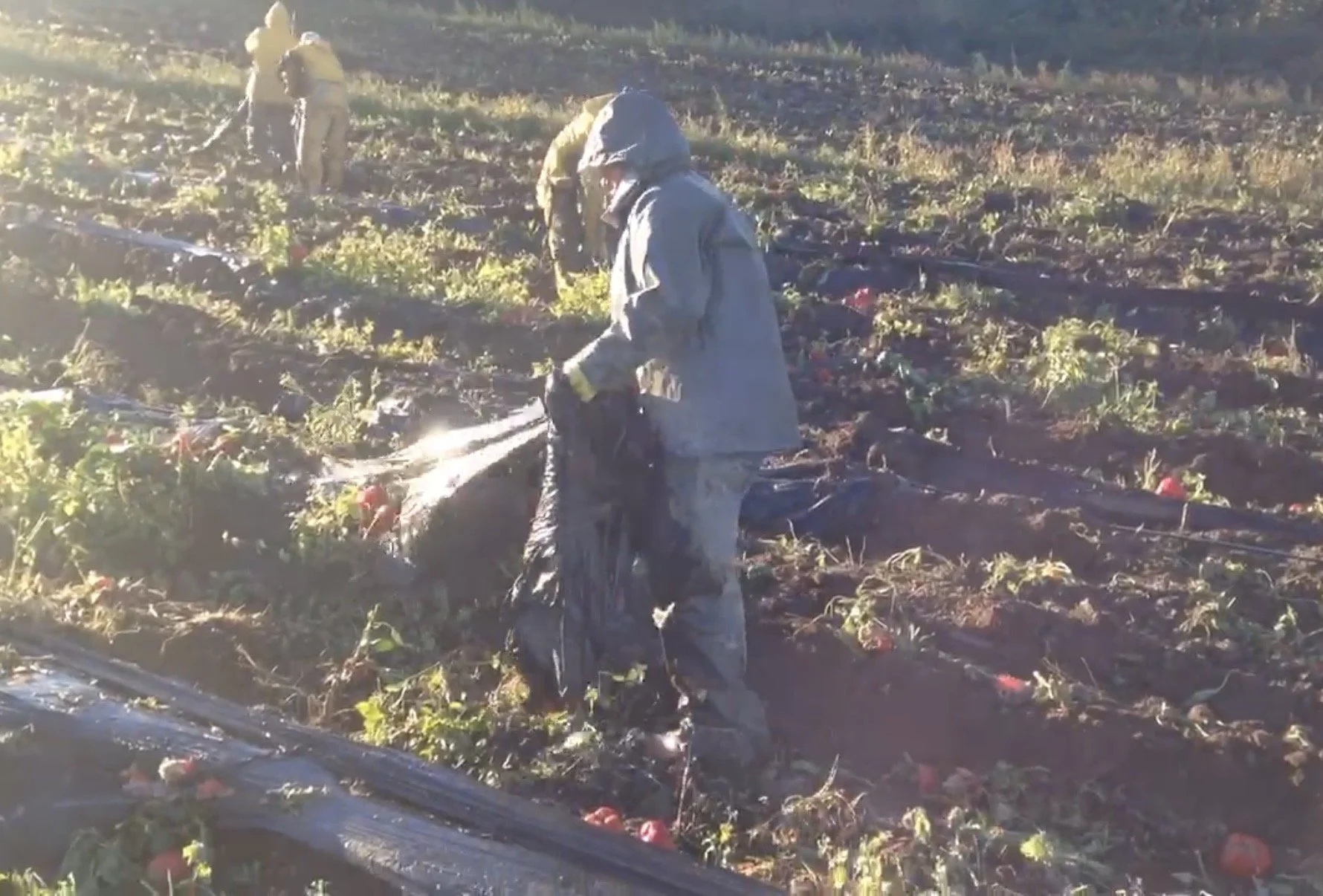
Manual removal of polyethylene mulch after harvest. Wet, soil-covered plastic requires significant labor, equipment handling, and disposal — adding hidden costs at the end of the growing season.
What growers actually deal with at the end of the season
Installing plastic mulch in the spring is relatively straightforward.
Removing it in the fall is a completely different job.
For many vegetable growers, plastic mulch removal becomes one of the most labor-intensive operations of the season. It involves machinery, workers, transport, and disposal — and it often takes place at the worst possible time of the year.
Plastic mulch performs well during the growing season. It helps warm the soil, suppress weeds, and improve crop yields in crops such as tomatoes, peppers, melons, cucumbers, squash, sweet potatoes, pumpkins, and many others.
But once harvest is finished, the system enters a phase that is often underestimated when calculating production costs:
plastic mulch removal.
At the end of the season, polyethylene mulch must be removed from the field, handled, transported, and disposed of. What appears to be a simple task quickly becomes a chain of operations that require time, labor, and coordination.
What happens after harvest: plastic mulch removal begins
When the crop cycle ends, plastic mulch does not disappear.
Someone has to remove it from the field.
The process usually begins with mowing crop residues. Even after harvest, plant material and vines remain in the field and must be cut before plastic removal can begin.
This step can become more difficult with vine crops such as melons, squash, or pumpkins, because vines often grow very close to the plastic mulch. This makes mowing slower and increases the risk of tearing the film during removal.
Once residues are cut, tractors equipped with mulch lifters begin pulling the plastic from the beds. As the film comes out of the soil, plastic mulch and drip irrigation lines are removed together.
Workers then collect the material as it comes out of the beds and load it onto wagons or trailers for removal from the field.
Film type also affects how mulch behaves during removal
Not all polyethylene mulch behaves the same when it is removed from the field.
Two main manufacturing processes are commonly used to produce agricultural mulch film: cast film and blown film.
Cast film often becomes more brittle after months of exposure in the field. When removal begins, the material may break into many small fragments, which can increase cleanup time and labor.
Blown film typically has higher tear resistance and may come out of the soil in larger sections during removal, which can make the operation somewhat easier.
However, even with stronger films, tearing and fragmentation are common after a full growing season.
Weather conditions make removal more difficult
Plastic mulch removal usually takes place late in the season, often during the fall.
At that time of year, conditions are rarely ideal.
Cold temperatures make polyethylene more brittle, increasing the likelihood that the film will tear during removal. Wet soils can also slow the process, as plastic often comes out covered in mud and becomes heavier to handle.
At the same time, growers are working against the calendar.
Days are shorter, temperatures are dropping, and winter is approaching. Every workable day becomes important.
In many cases, plastic must be removed whenever weather conditions allow — even if the material has already become fragile and difficult to handle.
Labor pressure and seasonal workers
Another factor affecting plastic removal is labor availability.
On many farms, part of the workforce consists of seasonal agricultural workers whose permits are tied to specific dates. As these dates approach, the window to complete field operations becomes limited.
In some situations, growers may even face difficult decisions — whether to continue harvesting crops or to shift crews toward removing plastic before labor permits expire or winter conditions arrive.
When this happens, plastic removal can take priority over other activities simply because it cannot be postponed indefinitely.
The cleaner the field, the higher the cost
Plastic mulch removal is not only about lifting the plastic from the beds.
What often determines the real cost of the operation is how clean the field needs to be afterwards.
There is a major difference between removing most of the plastic quickly and cleaning the field carefully so that very little plastic remains.
Once the mulch begins tearing during removal, workers often need to:
• walk the rows
• bend down repeatedly
• pick up pieces of plastic and drip tape left in the soil
Many farms also send workers back through the field after the main removal step to collect fragments that remain in the beds.
Plastic mulch removal is one of the few farm operations where doing the job properly often means the cost keeps increasing.
The cleaner the field needs to be, the more labor the operation requires.
From fragments to microplastics
During plastic mulch removal, fragments of polyethylene often remain in the field.
Even when growers take the time to clean rows carefully, small pieces of plastic can remain in the soil.
Polyethylene does not biodegrade. Instead, it slowly breaks into smaller fragments over time.
These particles are commonly referred to as microplastics, generally defined as plastic fragments smaller than 5 millimeters.
Microplastics can originate from several sources in agriculture, including degraded mulch films and plastic fragments left in the soil after removal.
Because these particles are extremely small, they can remain in agricultural soils for long periods of time.
(For a deeper explanation of this process, see our article on microplastics in agricultural soils.)
What plastic mulch removal actually involves
Typical operations required at the end of the season
☐ Scheduling the removal window between harvests and frost
☐ Coordinating the work before seasonal workers leave the farm
☐ Organizing tractors, mulch lifters, wagons and trailers
☐ Dispatching a crew to the field — often the same crew used for harvesting revenue crops, now doing cleanup work
☐ Checking weather conditions before starting
☐ Wet soil slowing equipment and increasing soil stuck to plastic
☐ Wind making plastic harder to collect and bundle
☐ Tractor mowing crop residues before removal
☐ Managing vines or plants tangled in the mulch
☐ Tractor lifting plastic mulch from the beds
(slower lifting usually means a cleaner job — but higher cost)
☐ Plastic mulch and drip irrigation lines coming out together
☐ Crew pulling plastic mulch along the rows
☐ Winding plastic mulch into bundles
– semi-automatic winders creating large bundles
– or manual winding creating smaller bundles
☐ Workers walking the rows to collect loose plastic fragments
☐ Loading plastic bundles onto wagons or trailers
☐ Transporting plastic from the field back to the farm
☐ Transferring plastic from wagons into a container or disposal pile
☐ Truck hauling the container to landfill
☐ Landfill tipping fees for agricultural plastic
And once the plastic is gone, another question often remains:
☐ Do we still have enough time to plant a cover crop?
In many seasons, the removal process pushes operations so late
that cover crops are delayed — or skipped entirely.
Some farms even postpone plastic cleanup until spring.
Every one of these steps disappears with compostable mulch.
Many growers find the overall system cheaper.
Looking ahead
Plastic mulch removal has been part of vegetable production systems for decades.
Growers understand the process well. It involves machinery, labor, transport, and disposal — often during one of the busiest and most unpredictable periods of the year.
And one thing is unlikely to change in the future.
Labor costs continue to rise. Disposal costs rarely decrease. Seasonal work windows remain tight.
In other words, the economics of plastic mulch removal are not likely to improve over time.
For this reason, some growers are beginning to look at different approaches to managing mulch systems at the end of the season.
Ready to try compostable mulch on your farm?
Most growers start with a small 2–3 acre trial to see how the system performs under their own field conditions.
Every field is different.
Bed height.
Crop cycle.
Rainfall exposure.
UV intensity.
Annual or perennial system.
Thickness alone does not determine performance.
Durability depends on how the system is engineered for the field.
Start with the right questions
Tell us:
• What crop are you growing?
• How many months of performance do you need?
• What is your typical bed height?
• How many acres are you currently covering with plastic mulch?
We will recommend the right system for your field conditions — not just a mil thickness.