
Understanding Plastics: The Practical Guide to Plastics, Bioplastics, Microplastics and End-of-Life
📘 Guide Contents
10 Chapters • Practical Examples • Scientific References
Introduction
Why this guide exists
Plastic, bioplastic, bio-based, biodegradable, compostable and oxo-degradable describe different characteristics. They do not mean the same thing.
One distinction is particularly important:
Where the carbon comes from does not determine whether the final plastic is biodegradable.
A plastic made from renewable carbon can still be persistent and non-biodegradable. Conversely, a biodegradable polymer can contain fossil-based carbon.
And fossil-based does not mean that a biodegradable plastic turns back into petroleum as it biodegrades. Carbon origin tells us where the carbon came from — not where the material will ultimately go.
This guide explains these distinctions in plain language while remaining scientifically accurate. Its purpose is to provide the basic concepts needed to understand how plastics are made, how polymer structure influences their behavior, how microplastics can be created, and how biodegradability is evaluated.
“Carbon origin tells us where the carbon came from.
Polymer chemistry helps determine how the material behaves.”
1. What Is Plastic?
Plastic is not one single material. It is a broad family of materials made primarily from polymers — very large molecules built from repeating molecular units.
The way these molecules are chemically structured strongly influences how a plastic behaves. Two materials may contain the same basic elements — including carbon — yet have very different properties because those atoms are assembled differently.
“Plastic” tells us very little by itself about where the carbon came from, how the material is structured, or how it will behave.
The Way We Evaluate Plastics Is Evolving
Historically, plastics were largely engineered around what they needed to do during their functional period: be strong, flexible, lightweight, stable, inexpensive and durable.
Those properties remain essential. But today, another question is increasingly important:
What should happen to the material after its functional period?
This is especially relevant when recovering the material after use is difficult — as is often the case in agriculture.
Understanding a plastic therefore requires looking at both its performance during use and what happens afterward.
And that leads to an important distinction:
Where the carbon comes from does not determine whether the final plastic is biodegradable.
2. Where Carbon Comes From Does Not Determine Where It Goes
One of the most common sources of confusion around plastics is the tendency to mix several very different questions.
Before going further, it helps to understand what carbon actually is.
First, What Is Carbon?
Carbon is one of the basic building blocks of life.
It is naturally present in plants, animals, food and the human body. The sugars in an apple contain carbon. So do bread, corn, wood — and even our own cells.
Carbon is also present in fossil resources such as oil and natural gas.
But here is the important point:
A carbon atom does not become “good” or “bad” simply because it came from a plant or from a fossil resource. What matters is how carbon atoms are combined with other atoms to form molecules and materials.
Think about something familiar.
An apple contains carbon. Gasoline contains carbon too.
Obviously, eating an apple and drinking gasoline are not remotely the same thing.
The difference is not the presence of carbon. The difference is how the atoms are assembled into molecules, and what substances are ultimately created.
The same principle helps us understand plastics.
Question 1 — Where Does the Carbon Come From?
Fossil or renewable?
This describes the origin of the carbon used to make the material.
The carbon used to manufacture a plastic may come from fossil resources such as oil or natural gas, or from renewable biological resources such as corn, sugar cane or other biomass.
This is what terms such as fossil-based and bio-based describe.
Renewable carbon can offer important environmental advantages, including reducing dependence on fossil carbon.
But carbon origin alone does not tell us what the final material will do after use.
Question 2 — What Material Was Ultimately Created?
And what is that material designed to do after its functional period?
Persist, be recycled, composted, or biodegrade under defined conditions?
This is a different question.
It concerns the structure and behavior of the final material, as well as the pathway for which the product was designed.
A plastic can therefore contain renewable carbon and still be a non-biodegradable, persistent plastic.
Likewise, a biodegradable polymer is not necessarily made entirely from renewable carbon.
Origin and biodegradability are separate characteristics.
And this distinction becomes much easier to understand with a familiar example.
🌽 It’s Made from Corn…
So It Must Be Better for the Environment, Right?
So It Must Be Biodegradable, Right?
So It Must Break Down Like Corn, Right?
Not necessarily. These are three different questions.
“Made from corn” tells us something important: where some or all of the carbon came from.
It does not, by itself, tell us what polymer was ultimately created.
It does not tell us whether that polymer is biodegradable.
And it does not tell us whether fragments of that polymer will persist in the environment.
Renewable origin and biodegradability should not be confused.
From Corn to Polyethylene
Consider polyethylene made using plant-derived ethanol.
The process can be simplified as:
🌽 Corn → Sugars → Ethanol → Ethylene → Polyethylene
The carbon originally came from corn.
But during manufacturing, those carbon-containing molecules are chemically transformed. The carbon is ultimately incorporated into long molecular chains that form polyethylene.
The result is no longer corn, sugar or ethanol.
It is polyethylene.
And polyethylene does not become biodegradable simply because the carbon used to produce it originally came from a plant.
Microorganisms encounter the polymer that was created — not the plant the carbon came from.
That is the key distinction.
What Changed?
The Molecular Structure.
Think of carbon atoms as building blocks.
The same basic building blocks can be arranged in very different ways to create materials with very different properties.
The origin of those building blocks matters when considering renewable versus fossil carbon.
But once a polymer has been created, the way its atoms are chemically connected becomes critical to how the material behaves.
Polyethylene, for example, has a highly stable carbon-carbon backbone.
Simplified:
Polyethylene
— C — C — C — C — C — C — C —
That molecular structure contributes to the durability that makes polyethylene useful for packaging, pipes, containers, agricultural films and many other applications.
It also means that conventional polyethylene is not readily broken down and assimilated by microorganisms.
Other polymers can have very different molecular structures.
For example, some biodegradable polyesters contain chemical bonds that are more susceptible to processes such as hydrolysis and enzymatic action under appropriate environmental conditions.
Simplified:
Some polyester structures
— C — C — O — C(=O) — C — O — C(=O) —
These differences in molecular structure can allow polymer chains to be progressively broken into smaller molecules that may ultimately become accessible to microorganisms.
This is fundamentally different from simply breaking a plastic object into smaller physical pieces.
⚠️ What About Microplastics?
This is where the distinction becomes especially important.
If a non-biodegradable polymer fragments into smaller and smaller pieces, its original carbon source does not make those fragments biodegradable.
For example, polyethylene can be produced from fossil carbon or renewable plant-based carbon.
In both cases, the final polymer is polyethylene.
If that polyethylene fragments into particles smaller than 5 mm, those particles are polyethylene microplastics.
A persistent microplastic does not become environmentally benign simply because its carbon originally came from a plant.
This is an essential distinction.
Renewable carbon tells us where the carbon came from.
Polymer structure helps determine what material was created.
Biodegradability describes whether microorganisms can ultimately convert that material under defined conditions.
Microplastic persistence concerns what may remain in the environment when a non-biodegradable plastic fragments.
These concepts are related — but they are not interchangeable.
Same Origin. Different Polymer. Different Behavior.
The same renewable carbon source can ultimately be used to manufacture different polymers with very different properties.
So:
Same renewable origin ≠ same polymer
and
Same renewable origin ≠ same environmental behavior
This is why bio-based should never be used as a synonym for biodegradable.
A bio-based plastic tells us something about where its carbon came from.
A biodegradable plastic tells us something different about what the polymer is capable of doing under defined environmental conditions.
Two Independent Questions
This distinction can be summarized using two separate axes:
Carbon Origin
Fossil ←────────────→ Renewable
Material Behavior
Persistent ←────────────→ Biodegradable under defined conditions
A material can therefore occupy different positions on these two axes.
A plastic may be:
fossil-based and persistent;
bio-based and persistent;
partly or fully bio-based and biodegradable; or
fossil-derived and biodegradable.
Where the carbon comes from does not determine where the polymer goes.
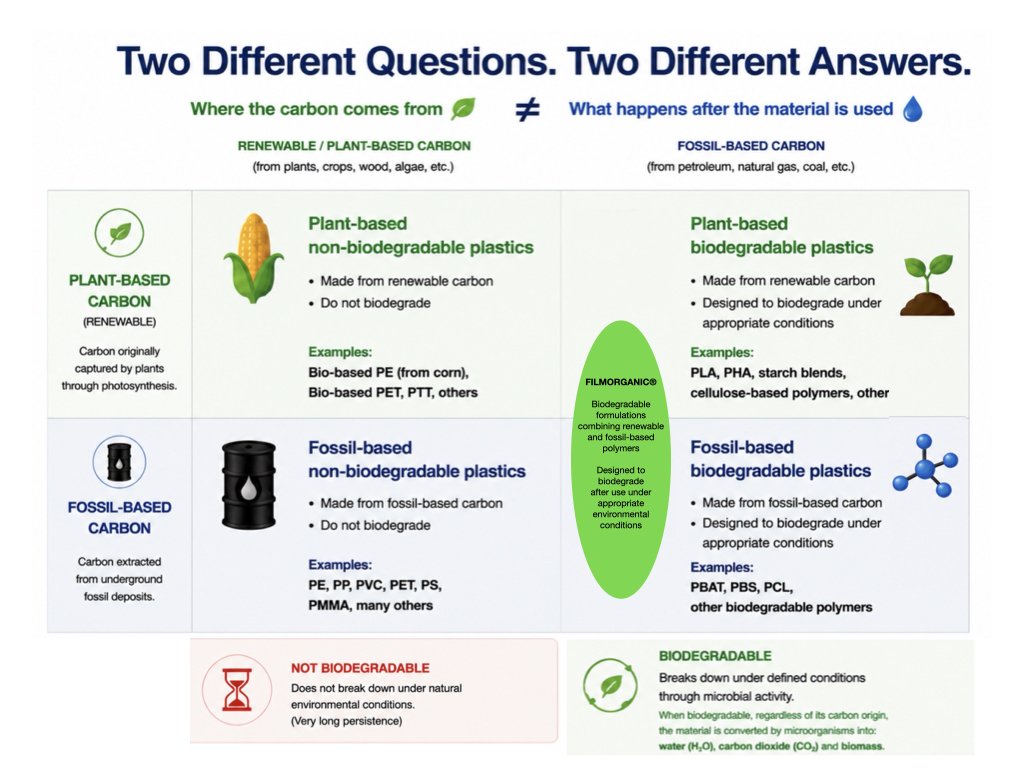
A material can be bio-based and persistent. It can also be fossil-based and biodegradable. Carbon origin and end-of-life behaviour are independent characteristics.
Each combination exists today.
This is why the word bioplastic, by itself, does not provide enough information to understand a material.
Looking Ahead
Once carbon origin and end-of-life are separated, another question emerges:
What should happen to a material after it has completed its function?
That question is increasingly becoming part of polymer design itself.
3. Designing What Happens After Use
For decades, plastics were primarily designed around what they needed to do during their functional period: provide strength, flexibility, durability, stability and low cost.
Today, another question has become essential:
What happens to the material after its functional period?
As Section 2 showed, carbon origin does not answer this question. A plastic made from renewable carbon can still be non-biodegradable and, if it fragments and persists in the environment, contribute to persistent microplastics.
For applications where plastic may remain in the environment, what happens after use can therefore be more important than whether its carbon originally came from plants or fossil resources.
The appropriate pathway depends on the application: reuse, recycling, composting or biodegradation under defined conditions.
Where the carbon came from matters. What happens to the material after use may matter even more.
4. Microplastics: What They Are and How They Form
Microplastics are defined by their size—not by the type of plastic they come from.
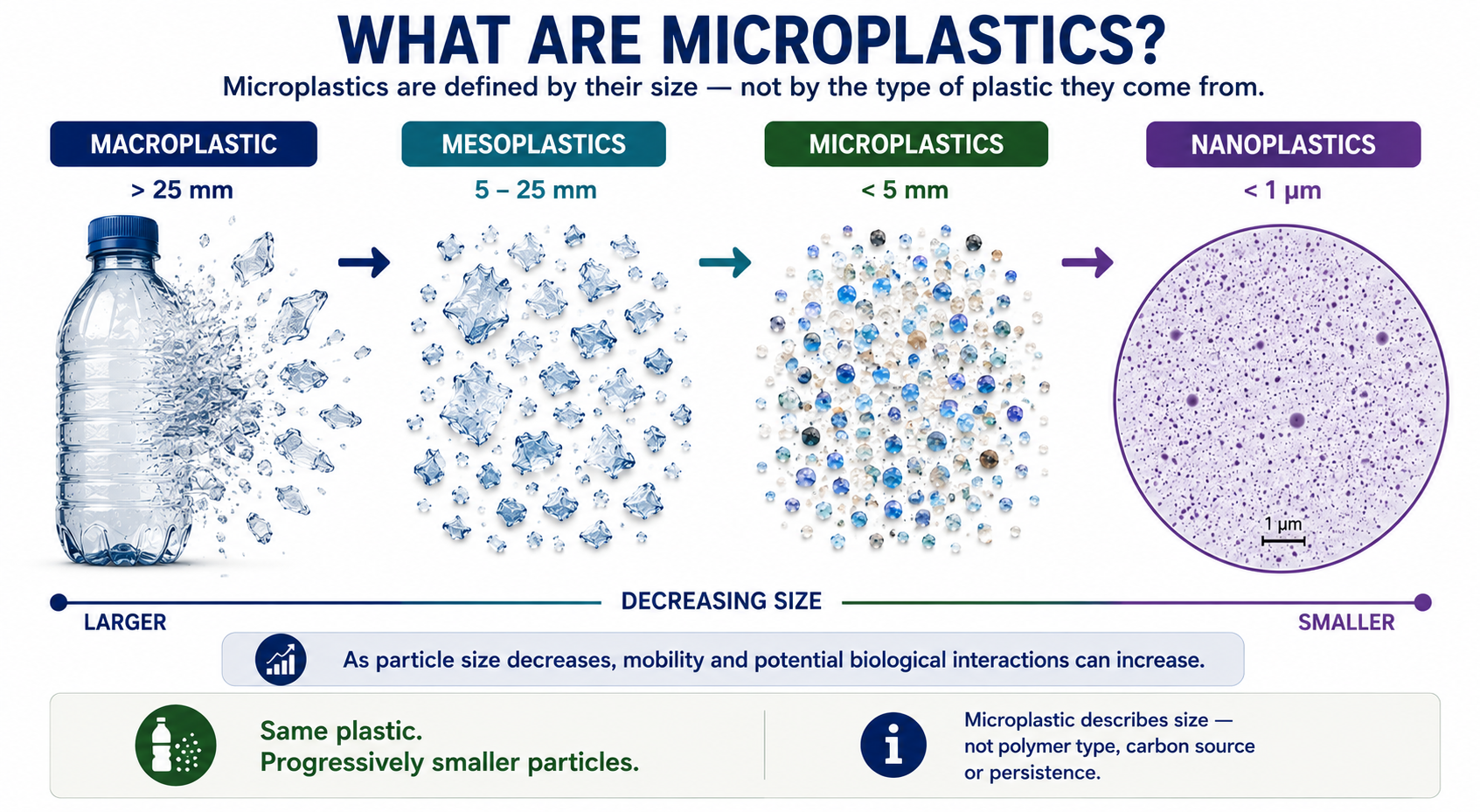
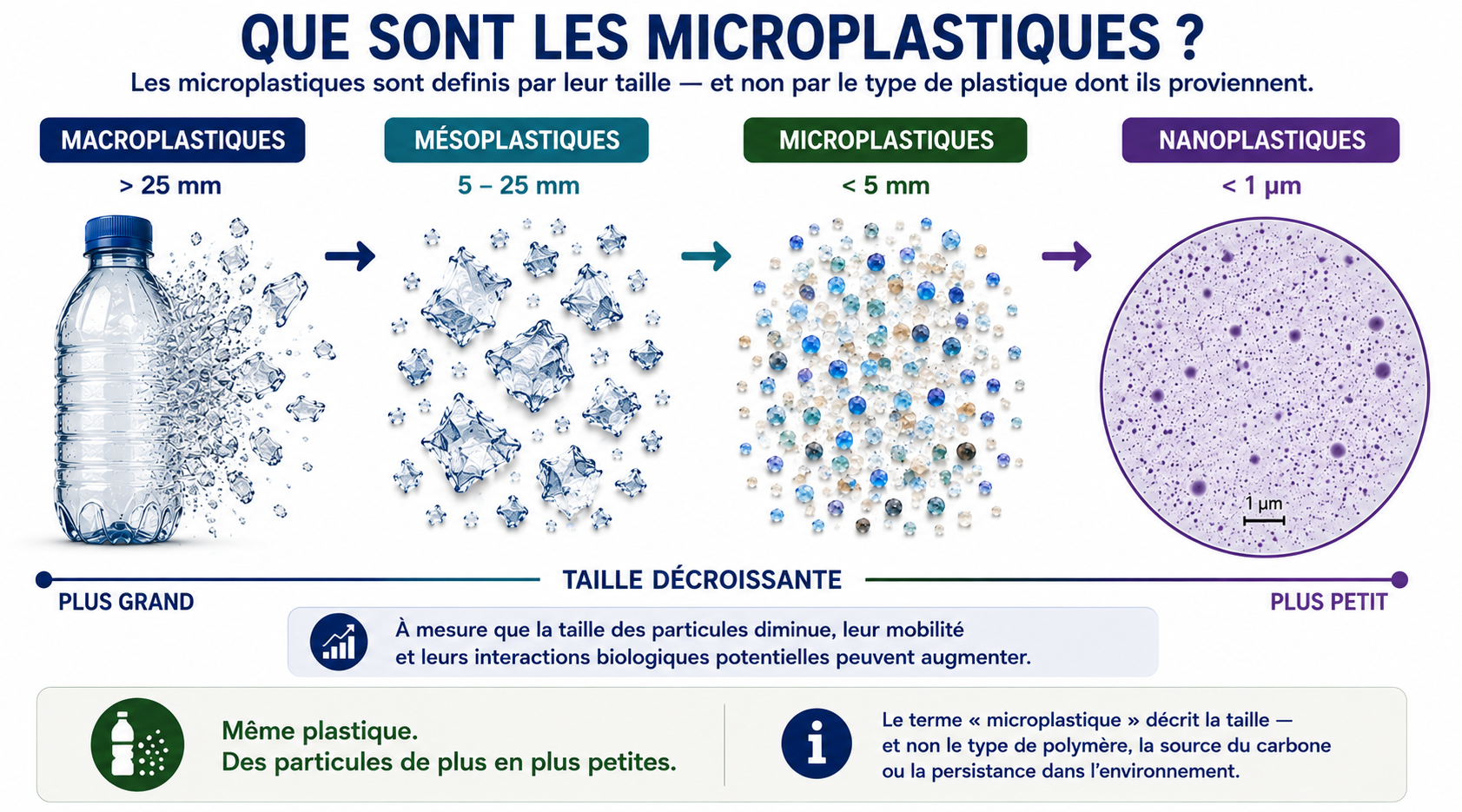
Microplastics are small plastic particles, generally defined as being smaller than 5 mm.
They can form when larger plastic products gradually break into smaller and smaller pieces. For agricultural plastics, this pathway is particularly important because films may be exposed to sunlight, heat, weathering, abrasion and mechanical activity before or after their functional period.
Fragmentation Is Not Biodegradation
As a plastic ages, it may crack, tear and eventually fragment into increasingly smaller particles.
Plastic product → cracks → fragments → smaller fragments → microplastics
But becoming smaller does not mean that the polymer has biodegraded.
A plastic can disappear from sight without disappearing from the environment.
If the polymer is not biodegradable under the conditions where it remains, the resulting particles can persist and continue to fragment.
Why Persistent Microplastics Matter
The concern is not simply their small size. It is the combination of small particle size, widespread dispersion and persistence.
In the environment, microplastics have been detected in water, sediments, soils and living organisms. In agricultural soils, plastic residues can accumulate through repeated inputs and interact with soil structure, water movement, microorganisms and other components of the soil ecosystem.
Their small size also makes them difficult — and in many situations practically impossible — to recover once dispersed.
Once persistent plastic has fragmented into microplastics and dispersed through soil, recovering it becomes fundamentally different from collecting the original plastic product.
Microplastics and Human Exposure
Microplastics have also been detected in food, drinking water, air and human tissues, demonstrating that human exposure occurs through multiple pathways.
Research is actively investigating their potential effects on human health, including possible relationships with inflammation, oxidative stress and other biological responses. However, the science is still developing, and the presence of microplastics in the human body does not by itself establish that they cause a specific disease.
This distinction is important: there is sufficient reason to reduce unnecessary exposure and environmental accumulation without overstating what science has not yet established.
Carbon Origin Does Not Solve the Problem
This brings us back to Section 2.
A non-biodegradable plastic made from renewable carbon can still fragment into persistent microplastics.
The microorganisms encountering those particles encounter the polymer that was ultimately created — not the corn, sugar cane or other original source of its carbon.
A persistent microplastic does not become environmentally harmless simply because its carbon originally came from a plant.
Fragmentation vs. Biodegradation
Fragmentation makes plastic smaller. The polymer remains.
Biodegradation involves microorganisms converting a biodegradable material, under appropriate conditions, into substances such as carbon dioxide, water and biomass.
And that distinction leads directly to the next question:
The environmental question is not simply whether the plastic disappears. It is what it becomes.
5. Why Some Plastics Are Designed to Biodegrade
Fragmentation changes the size of a plastic. Biodegradation changes the polymer itself.
Two Fundamentally Different Processes
One of the most important distinctions in understanding plastics is the difference between fragmentation and biodegradation.
They are not the same process.
Fragmentation changes the size of a plastic.
A larger piece becomes smaller pieces. Those pieces may eventually become microplastics or even smaller particles.
But the polymer itself may remain chemically recognizable.
Biodegradation changes the polymer itself.
Microorganisms and their enzymes act on molecules that can ultimately be metabolized, progressively converting the carbon contained in the material into products such as carbon dioxide, water and biomass under appropriate conditions.
Fragmentation makes a material smaller.
Biodegradation transforms the material itself.
This distinction is fundamental.
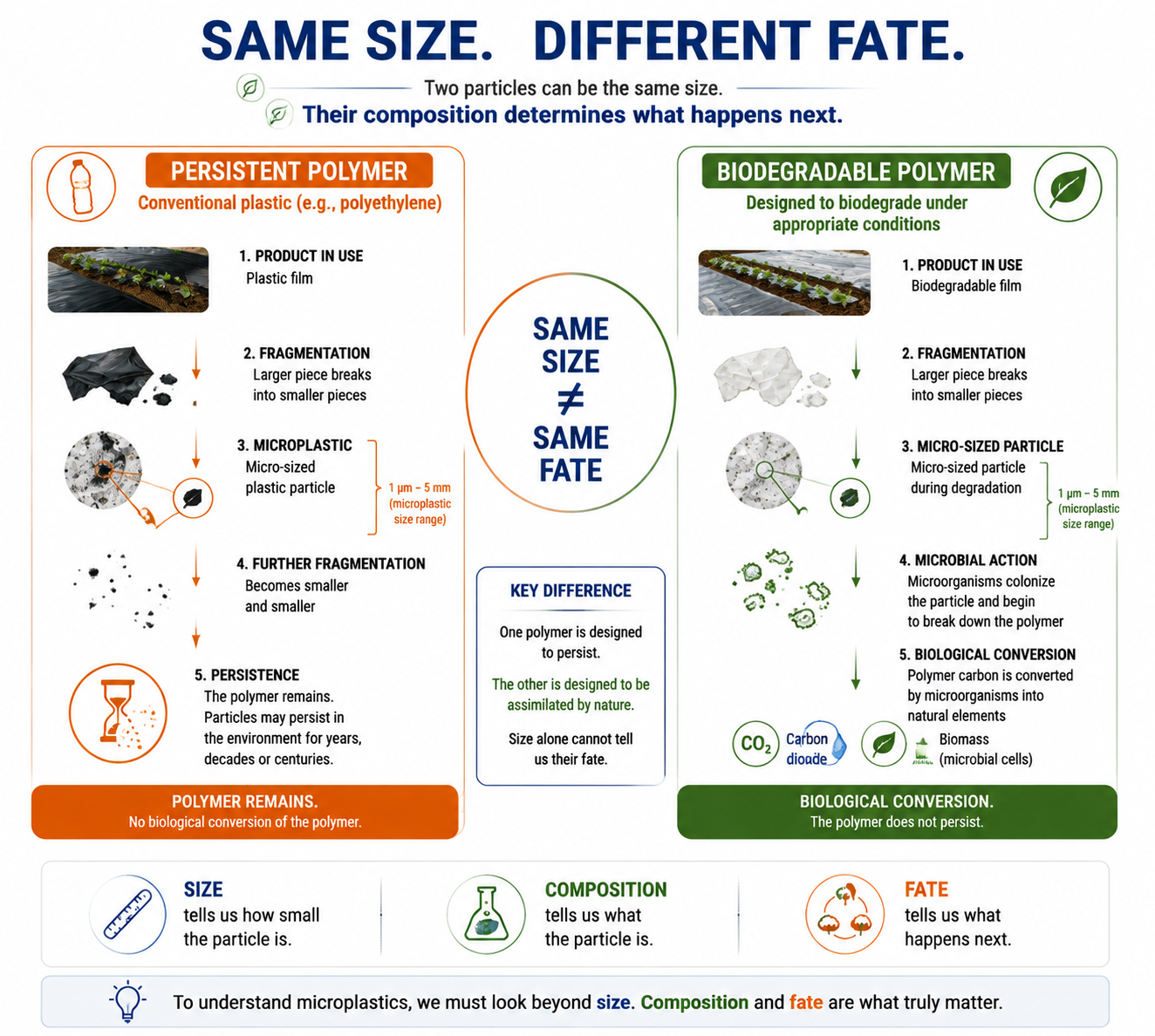
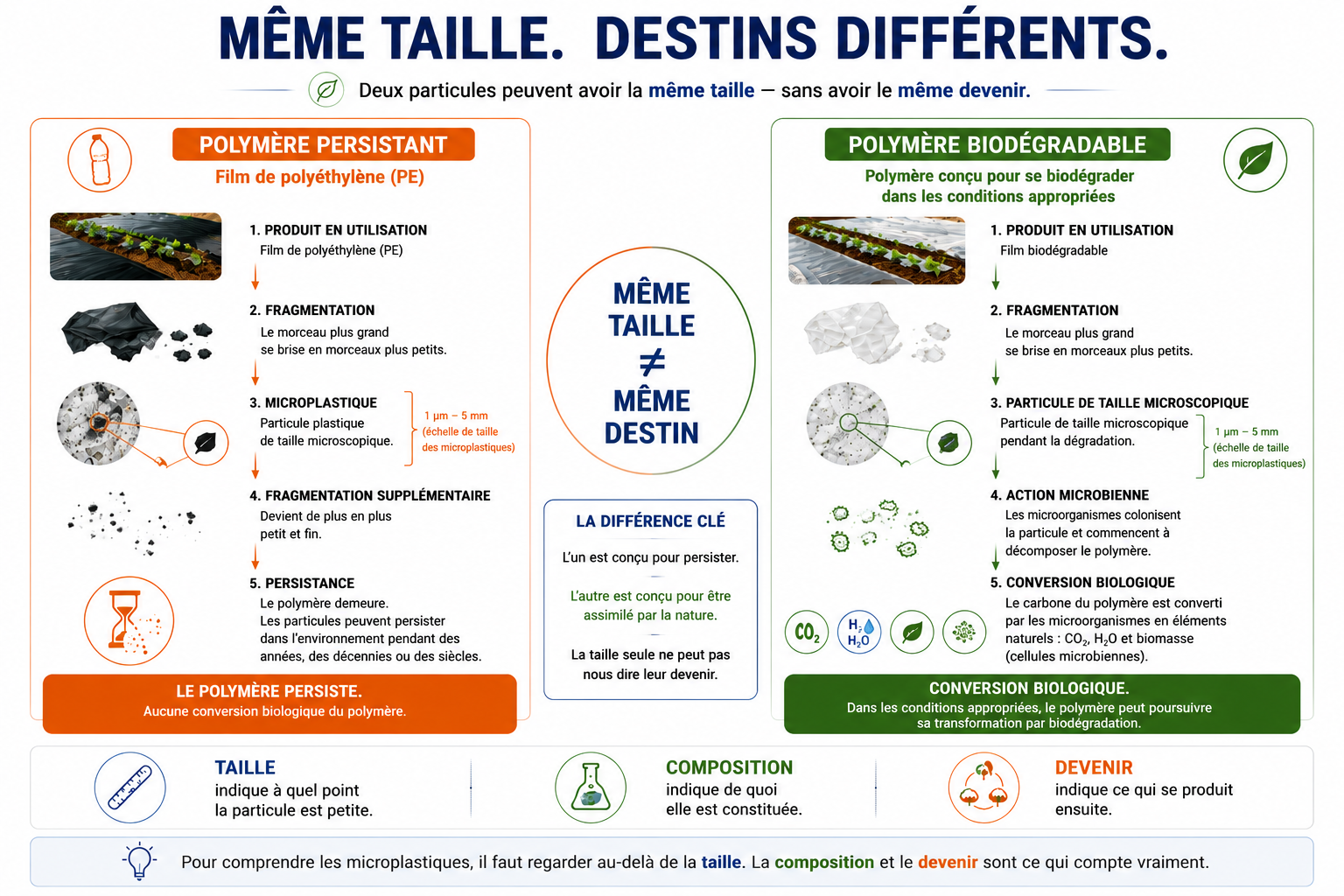
Same Size. Different Fate.
The previous chapters established an important principle:
“Micro” describes size.
“Plastic” describes the material.
Now we need to add a third question:
What happens next?
Imagine two plastic particles of similar microscopic size.
One is a fragment of polyethylene (PE).
The other comes from a plastic polymer designed and demonstrated to biodegrade under the conditions being considered.
At that moment, both may be plastic particles within the microplastic size range.
Their size alone does not tell us their environmental fate.
The polyethylene particle can remain polyethylene as physical and environmental forces continue to make it smaller.
The biodegradable polymer follows a fundamentally different pathway when appropriate biological conditions are present: its molecular structure can be broken down and its carbon ultimately metabolized by microorganisms.
So the important scientific question is not simply:
Does a small particle exist?
It is also:
Is that particle persistent, or is the material continuing through a demonstrated biodegradation pathway?
This is why particle size alone cannot describe the complete environmental behaviour of a material.
A Simple Analogy: A Lozenge
Consider a lozenge slowly dissolving in your mouth.
It begins as one solid object.
Then it becomes smaller.
Smaller still.
For a period of time, small pieces may exist.
But observing those smaller pieces at one particular moment would not describe the complete process.
They are in transition.
The analogy is not meant to represent the biological mechanism of polymer biodegradation. Dissolution and biodegradation are different processes.
But it illustrates an important concept:
The presence of smaller pieces at an intermediate moment does not, by itself, tell us whether those pieces will persist.
To understand that, we must know what the material is made from and what happens to it afterward.
Biodegradation Means Biological Conversion
True biodegradation goes beyond physical disappearance.
A material disappearing from sight is not sufficient evidence that it has biodegraded.
The fundamental process involves microorganisms.
Under appropriate environmental conditions, microorganisms and their enzymes act on biodegradable materials, breaking molecular structures down into compounds that can be biologically utilized.
The carbon contained in the polymer can ultimately be converted into products such as:
carbon dioxide
water
biomass
Under anaerobic conditions, methane may also be produced.
This biological conversion is what distinguishes biodegradation from simple fragmentation.
The objective is not to make plastic invisible.
The objective is biological conversion of the material.
Why Design a Plastic to Biodegrade?
For many applications, long-term durability is exactly what we want.
Water pipes, building materials, electrical components and many medical products are expected to remain stable for years or decades.
Biodegradation would provide little advantage during their intended use.
But other products have a deliberately limited functional period.
Agricultural mulch films are one example.
Certain organic-waste collection bags and food-service applications are others.
For these applications, recovering every piece of material after use can be difficult, inefficient or incompatible with the intended end-of-use system.
Scientists therefore developed polymers that can provide the required performance during use, while also offering a different pathway after use.
This is not about replacing every conventional plastic with a biodegradable one.
It is about matching the material to the application.
The right material.
For the right application.
With the right end-of-life pathway.
Biodegradation Requires the Right Conditions
Biodegradation is a biological process, and biological processes depend on their environment.
Important factors can include:
Temperature
Microbial activity generally changes with temperature.
Moisture
Water is essential to biological activity.
Microorganisms
Different environments contain different microbial communities.
Oxygen
Some biodegradation pathways are aerobic; others occur under anaerobic conditions.
Time
Biological conversion does not occur instantaneously.
Material chemistry and structure
Not every polymer is accessible to microbial degradation in the same way.
For this reason, the statement “biodegradable” is incomplete unless the conditions and pathway are understood.
A material may be biodegradable under industrial composting conditions, in soil, or in another defined environment.
These are not automatically equivalent claims.
Designed for a Specific End-of-Life Pathway
This brings us back to the broader principle introduced earlier in the guide.
There is no universally superior plastic.
The appropriate material depends on what the product must do during use and what should happen after that function is complete.
In some applications, reuse or recycling may be the appropriate pathway.
In others, long-term durability is essential.
And in specific applications where material is intentionally intended to enter a biologically active system, designing for biodegradation can provide another pathway.
Whenever technically appropriate, the origin of the carbon can also be considered.
This brings the broader design philosophy into focus:
The right material.
For the right application.
With the right end-of-life pathway.
Prioritizing renewable carbon whenever technically appropriate — without compromising performance.
How Do We Know It Actually Biodegrades?
There is one remaining problem.
A manufacturer can claim that a product is biodegradable.
But a claim is not scientific evidence.
If biodegradation depends on microbial conversion, environmental conditions and time, then these characteristics must be measured using defined methods.
Questions must be answered:
How much of the material actually biodegrades?
Under what conditions?
Over what period of time?
Does the material merely fragment, or is its carbon biologically converted?
Are there requirements concerning disintegration, ecotoxicity or other characteristics?
This is where standardized testing and independent certification become important.
Looking Ahead
Understanding biodegradation gives us the mechanism.
The next step is understanding how that mechanism is scientifically verified.
Standards establish defined test conditions, performance criteria and methods for evaluating material claims.
Certification can then provide independent verification that specified requirements have been met.
Biodegradable is a claim.
Testing provides evidence.
Certification verifies performance against defined requirements.
6. Understanding Certification Standards
Certification standards do not exist to create marketing claims. They exist to verify scientific claims.
The word “biodegradable” alone does not tell us enough.
Biodegradation depends not only on the polymer, but also on the environment in which it is expected to biodegrade. Temperature, moisture, microorganisms, oxygen and time can all influence the process.
This is why standards and certification matter.
They establish defined test conditions and performance criteria that allow biodegradability or compostability claims to be evaluated using recognized methods.
“Biodegradable” describes a property. Certification defines the conditions and evidence used to verify it.
Different Environments Require Different Standards
A material designed for industrial composting is not necessarily designed to biodegrade in soil. Likewise, soil, compost and marine environments should not be treated as interchangeable.
The relevant standard must therefore correspond to the material's intended pathway after its functional period.
Depending on the standard, testing may evaluate:
Biodegradation — whether microorganisms convert the polymer into substances such as carbon dioxide, water and biomass under defined conditions.
Disintegration — where applicable, whether the material physically breaks down within specified conditions and timeframes.
Environmental safety — whether applicable requirements for ecotoxicity and substances of concern are met.
Standards exist for different applications and environments, including industrial composting, soil biodegradation and biodegradable agricultural mulch films.
The important questions are therefore not simply “Is it biodegradable?” but:
Under what conditions? According to what standard? And for what intended environment?
The label matters less than the evidence behind it.
7. Understanding Oxo-Degradable Plastics
Oxo-degradation accelerates fragmentation. It does not, by itself, demonstrate complete biodegradation.
What Is an Oxo-Degradable Plastic?
An oxo-degradable plastic starts with a simple but essential fact:
The underlying plastic polymer — commonly polyethylene (PE) — is not a biodegradable polymer.
An oxo-degradable polyethylene is conventional PE containing additives designed to accelerate oxidation when the material is exposed to conditions such as heat, oxygen and ultraviolet radiation.
As oxidation progresses, the polyethylene can lose molecular weight, become increasingly brittle and fragment into progressively smaller pieces.
But the essential distinction is this:
The additive changes how the polyethylene breaks down and fragments.
It does not turn polyethylene into a biodegradable polymer.
The process can therefore be understood very simply:
NON-BIODEGRADABLE PE
↓
PRO-OXIDANT ADDITIVE
↓
OXIDATION
↓
BRITTLENESS
↓
FRAGMENTATION
↓
SMALLER PE PARTICLES
The pieces have changed size.
The underlying material is still polyethylene.
If those polyethylene fragments become sufficiently small, they enter the size range we call microplastics.
This brings us directly back to one of the most important principles established earlier in this guide:
Fragmentation changes size.
Biodegradation changes the material through biological conversion.
And it leads to a remarkably simple question:
IS THE POLYMER ITSELF BIODEGRADABLE?
If the polymer is not biodegradable under the relevant environmental conditions, making it progressively smaller does not, by itself, solve the persistence problem.
Why It Can Look Like Biodegradation
Oxo-degradable plastics can create a powerful visual impression.
A plastic film is initially visible and intact.
Exposure to environmental conditions makes it increasingly brittle.
It cracks.
It tears.
The fragments become smaller.
Eventually, much of the original product may become difficult or impossible to see with the naked eye.
To an observer, the plastic may appear to have disappeared.
But disappearance from sight is not evidence of biodegradation.
Consider what has actually happened:
The film disappeared.
The polyethylene did not necessarily disappear.
The scientifically important question is therefore not:
Can I still see the film?
It is:
What happened to the polymer?
If non-biodegradable polyethylene has simply become smaller polyethylene particles, the product may have disappeared visually while the polymer remains in the environment.
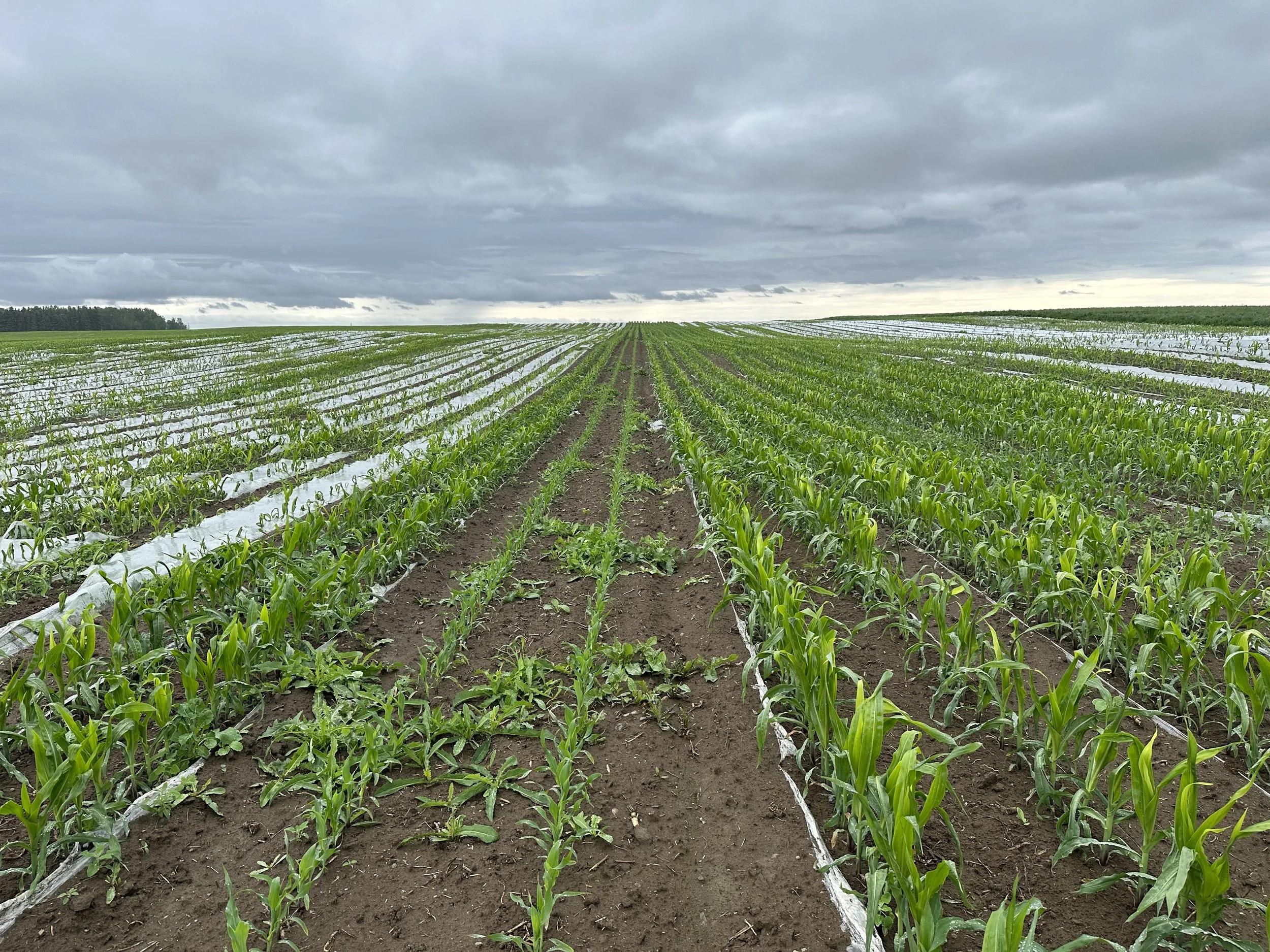
Oxo-degradable mulch film in the field.
As the film is exposed to sunlight, heat, oxygen and mechanical stress, it can become brittle and fragment into progressively smaller pieces. From a distance, the material may appear to be disappearing. But visual disappearance is not the same as biodegradation. Unless the polymer itself is biologically converted under appropriate conditions, the process may simply transform a visible plastic film into smaller plastic fragments that are increasingly difficult to recover. This is why the distinction between fragmentation and biodegradation is fundamental when evaluating agricultural mulch films. The key question is not only whether the film can still be seen — but what the polymer has become, and what happens to it next.
The Microplastics Problem
This is where the distinction becomes particularly important.
An intact polyethylene mulch film is plastic.
A large fragment of that film is still polyethylene.
A smaller fragment is still polyethylene.
And when a persistent polyethylene fragment becomes small enough to fall within the microplastic size range, we give it another name:
a polyethylene microplastic.
The polymer did not become a microplastic because its chemistry suddenly changed.
It became a microplastic because its size changed.
This brings together three principles established earlier in this guide:
SIZE tells us how small it is.
COMPOSITION tells us what it is.
FATE tells us what happens next.
For oxo-degradable polyethylene:
SIZE → progressively smaller through fragmentation
COMPOSITION → polyethylene
FATE → depends on whether biological conversion of that polymer is actually demonstrated under relevant conditions
This is why accelerating the fragmentation of conventional polyethylene is fundamentally different from designing a polymer for demonstrated biodegradation.
A plastic can disappear from view without disappearing from the environment.
A Regulatory Perspective
The concern is not merely theoretical.
The Government of British Columbia states that oxo-degradable plastics contain additives that break down into “microplastics that pollute the environment.” The Province also notes that these materials are often marketed as biodegradable, green, or eco-friendly.
Since July 15, 2024, businesses in British Columbia can no longer sell or distribute packaging or single-use products containing oxo-degradable plastic. The regulation includes limited exemptions, including certain devices and products intended for sale or distribution outside British Columbia.
This regulatory language is particularly significant because it focuses on the same distinction developed throughout this guide:
Fragmentation into microplastics should not be confused with demonstrated biodegradation.
Source:
Government of British Columbia — Single-Use and Plastic Waste Prevention Regulation
Regulatory Action Beyond British Columbia
Concerns over oxo-degradable plastics have led to regulatory action in multiple jurisdictions, including the European Union, British Columbia, California and New Zealand. The United Kingdom has also formally raised concerns about their potential to release microplastics and has considered further regulatory action.
Sources:
European Union — Directive (EU) 2019/904
California Legislature — AB-1290
New Zealand Ministry for the Environment — Plastic products banned from October 2022
Bio-Based Does Not Change the Definition
There is another distinction worth making.
A plastic can be made partly — or even entirely — from renewable carbon and still be a persistent plastic.
Likewise, a biodegradable polymer can contain fossil-derived carbon and still be capable of biodegradation under defined conditions.
These are not contradictions.
They are simply answers to two different questions:
Bio-based describes where the carbon comes from.
Biodegradable describes what can happen to the material after use.
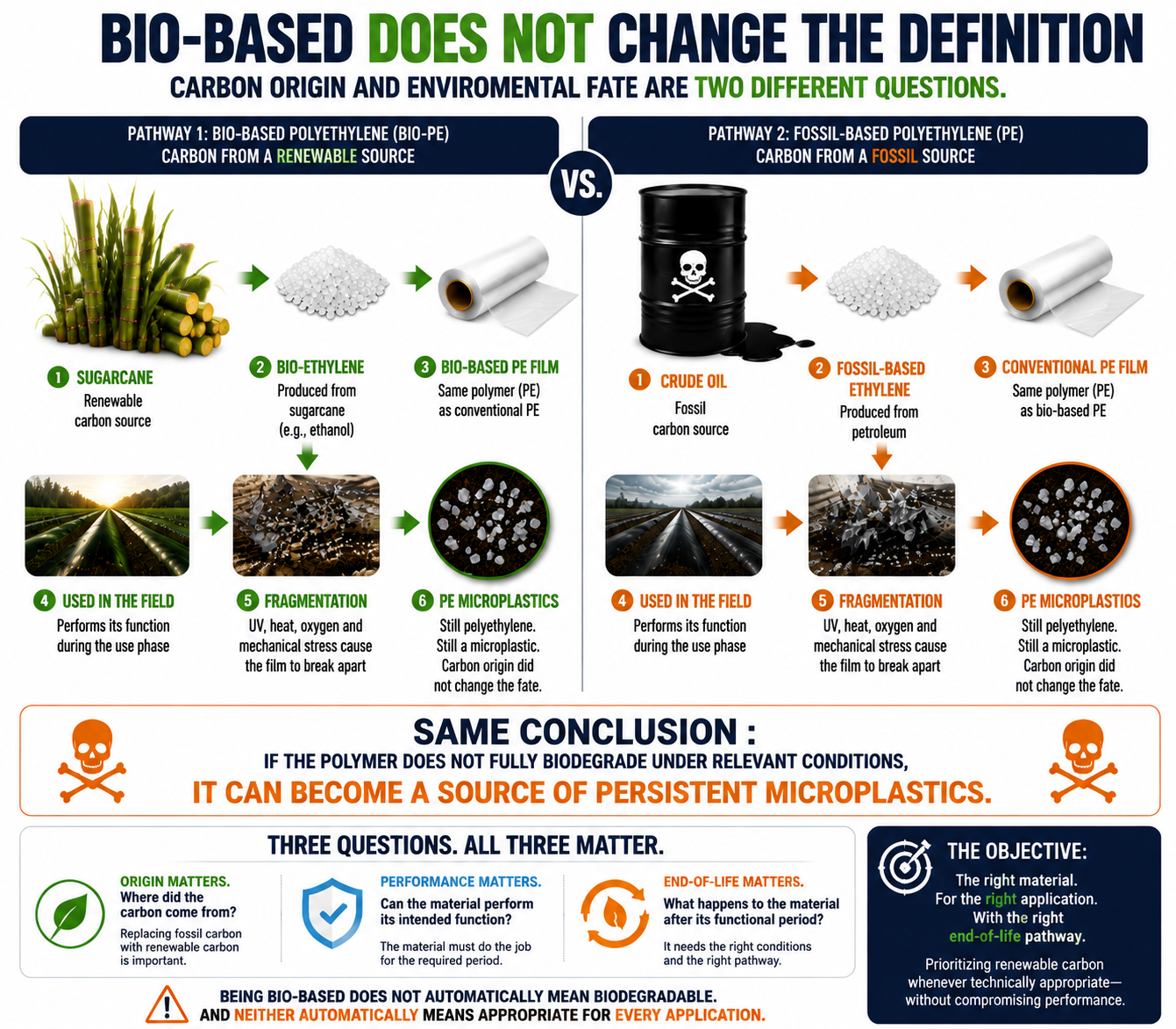
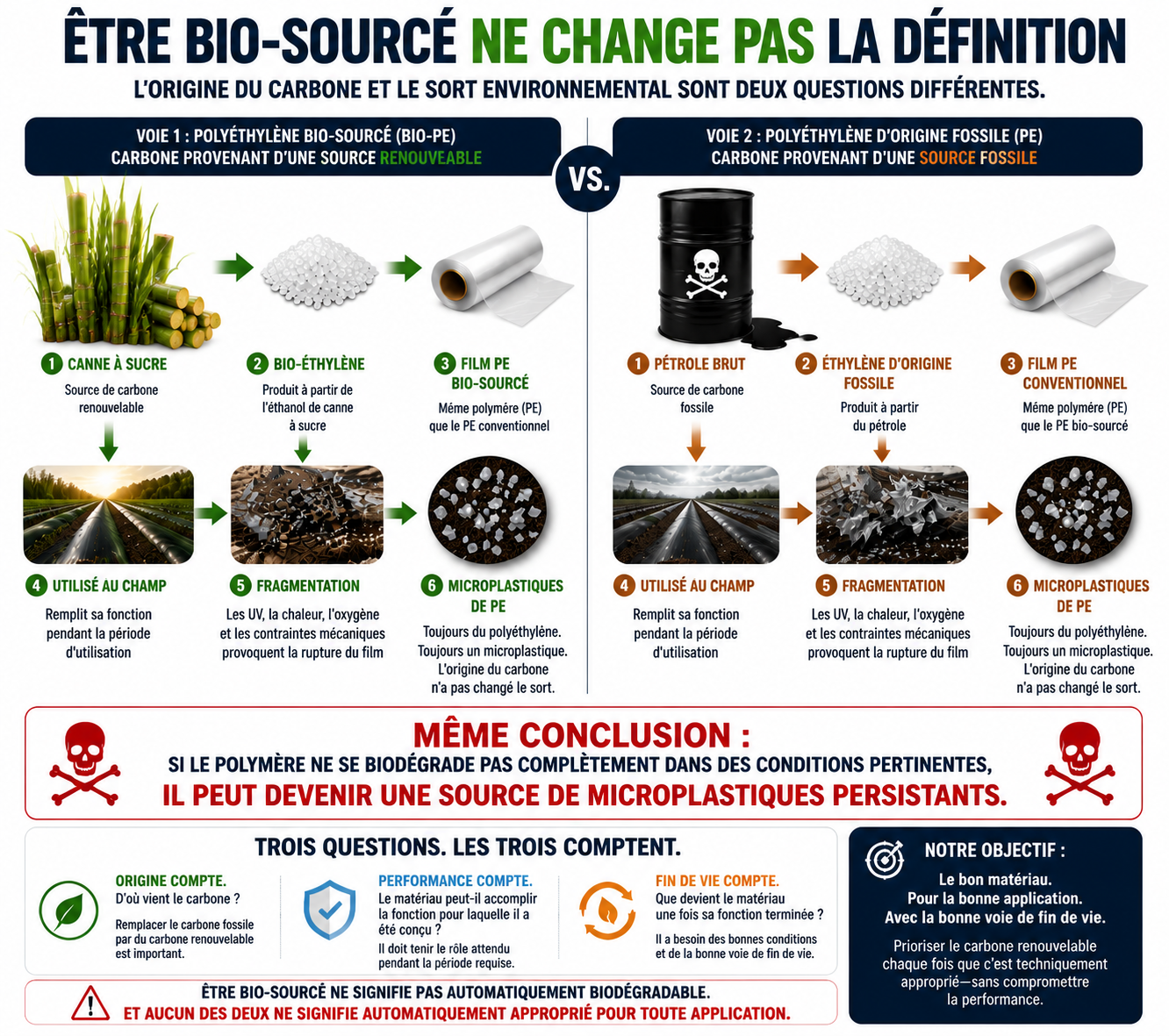
Consider a familiar example.
Polyethylene can be made from sugarcane instead of petroleum.
The carbon source has changed.
The polymer can still be polyethylene.
And if that bio-based polyethylene fragments into microscopic pieces, those pieces are still polyethylene microplastics.
Renewable carbon does not make a persistent polymer biodegradable.
The reverse is equally important.
A biodegradable polymer does not have to be 100% bio-based. Its ability to biodegrade depends on its molecular structure and its interaction with biological processes, not simply on whether its carbon originally came from a plant or a fossil resource.
This is why labels such as plant-based, bio-based, renewable, biodegradable and compostable should never be treated as synonyms.
A bottle made from bio-based PE may contain renewable carbon and remain persistent.
A conventional PE film may contain fossil carbon and remain persistent.
A certified compostable material may combine renewable and fossil-derived carbon while being designed for biological conversion under defined conditions.
And a leaf is almost entirely renewable biological material — yet we would never need a certification logo to understand that carbon origin and environmental fate are different concepts.
The important lesson is not that renewable carbon does not matter.
It does.
Replacing fossil carbon with renewable carbon can reduce dependence on fossil feedstocks and can be an important part of material selection.
But renewable carbon cannot compensate for an inappropriate end-of-life pathway.
And biodegradability cannot compensate for a material that fails during its required functional period.
Renewable does not automatically mean biodegradable.
Biodegradable does not automatically mean renewable.
And neither automatically means appropriate for every application.
This is why environmental claims should never be evaluated from a single characteristic.
Origin matters.
Where did the carbon come from?
Performance matters.
Can the material perform the function for which it was designed?
End-of-life matters.
What happens to the material when that function is complete?
The objective is not to maximize one characteristic while ignoring the others.
It is to bring them together:
The right material.
For the right application.
With the right end-of-life pathway.
Prioritizing renewable carbon whenever technically appropriate — without compromising performance.
Why Agricultural Mulch Makes This Especially Relevant
Agricultural mulch films operate in conditions that can strongly promote weathering.They are thin.They cover large surface areas.They are exposed to sunlight, heat, oxygen, moisture, wind, agricultural equipment and mechanical stress.For an oxo-degradable mulch film, fragmentation can therefore appear to solve an operational problem: the film becomes increasingly brittle and may eventually become difficult to recover.But that creates the fundamental question:Has the plastic biodegraded — or has it simply become too small to collect?For agricultural soils, that distinction matters.Once persistent plastic fragments become sufficiently small and dispersed through soil, recovering them becomes increasingly difficult.A product designed for agricultural use should therefore be evaluated not only according to whether it disappears visually, but according to what happens to the polymer after its functional period is complete.
The Question to Ask
The chemistry can become complex.The practical question does not have to be.When evaluating any plastic promoted as degradable, ask:What is the polymer?What causes it to break down?Does it fragment?Has complete biodegradation been demonstrated under relevant conditions?What remains afterward?And ultimately:What happens to the carbon?That final question helps distinguish physical fragmentation from biological conversion.
Looking Ahead
Oxo-degradable plastics demonstrate why evaluating a plastic requires looking beyond simple observations.
A material may become brittle, fragment, or disappear from sight, but these changes alone do not demonstrate biodegradation.
The key question remains:
What happens to the material after use?
Understanding plastics requires looking at the complete pathway:
Where does the carbon come from?
What is the polymer structure?
How was the material designed to behave after use?
The next section brings these concepts together.
8. Conclusion
The Right Material for the Right Application
Plastics are not one material, and they should not be evaluated through a single characteristic.
One of the most important distinctions is also one of the simplest:
Where the carbon comes from does not determine what happens to the plastic after use.
Renewable carbon can reduce dependence on fossil resources, and increasing its use where technically appropriate is an important objective. But bio-based does not automatically mean biodegradable. A non-biodegradable plastic made from renewable carbon can still persist and, if fragmented and dispersed, contribute to persistent microplastics.
Conversely, a biodegradable polymer may contain fossil-based carbon and still be designed to biodegrade under appropriate conditions.
This is why what happens after the material's functional period deserves as much attention as where its carbon originally came from.
For applications where plastics can be effectively collected and recycled, durable materials may be entirely appropriate. Where recovery is difficult or unrealistic, materials designed to biodegrade under the conditions of use may offer a different pathway.
The objective should therefore not be to classify plastics simply as good or bad, plant-based or fossil-based.
It should be to ask better questions:
What does the material need to accomplish?
How long does it need to perform?
What will realistically happen to it afterward?
And what evidence supports that outcome?
The right material, for the right application, with the right pathway after use.
Prioritizing renewable carbon whenever technically appropriate — without compromising performance or what happens afterward.
9. Glossary
A Note on Terminology
Terms related to plastics are not always used consistently across scientific literature, regulations, standards, industry and everyday language.
The definitions below reflect how these terms are used throughout this guide. Where a regulatory, testing or certification definition is important, the applicable standard or primary source should always be consulted.
Three Questions to Keep Separate
Many misunderstandings about plastics begin when different characteristics are treated as though they mean the same thing.
A useful starting point is to separate three questions:
SIZE — How small is it?
COMPOSITION — What is it made of?
FATE — What happens to it next?
The same discipline applies to environmental claims:
BIO-BASED — Where did the carbon come from?
BIODEGRADABLE — Can biological processes convert the material under defined conditions?
COMPOSTABLE — Does the material meet defined requirements within a specified composting environment?
These terms describe different characteristics. They are not interchangeable.
Core Terms
Additive
A substance incorporated into a material to provide or modify a property such as flexibility, stability, colour, UV resistance, processing behaviour or oxidation response.
Bio-Based
Describes material derived partly or entirely from renewable biological resources.
Bio-based describes origin; it does not automatically mean biodegradable.
Biodegradable
Describes a material capable of being broken down through biological activity under appropriate conditions, ultimately resulting in substances such as carbon dioxide, water, biomass and, depending on the environment, other naturally occurring products.
Biodegradation depends on both material chemistry and environmental conditions.
Biodegradation
The biological conversion of a material through the activity of microorganisms.
It should not be confused with fragmentation, which can make a material smaller without completing biological conversion.
Biological Conversion
The transformation of material through biological processes rather than simply physical fragmentation.
Certification
Independent confirmation that specified requirements have been assessed according to a defined certification scheme.
Certification provides evidence about the characteristics covered by that scheme; it does not necessarily answer every question about every real-world environment.
Compostable
Describes a material that meets defined requirements for biodegradation, disintegration and other criteria within a specified composting environment.
Compostable and biodegradable are related terms, but they are not synonyms.
Disintegration
The physical breakdown of a material into pieces small enough to satisfy a defined test criterion.
Disintegration concerns physical form and should not be confused with complete biodegradation.
End-of-Life Pathway
The intended or actual pathway of a product after its useful function is complete, such as reuse, recycling, composting, biological conversion, disposal or environmental release.
Fossil Carbon
Carbon originating from fossil resources such as petroleum, natural gas or coal.
Fragmentation
The physical breakdown of a material into progressively smaller pieces.
Fragmentation changes size. It does not, by itself, demonstrate biodegradation.
Functional Period
The period during which a material must retain sufficient properties to perform its intended function.
Home Composting
Composting under household or small-scale conditions, generally involving lower and more variable temperatures than controlled industrial composting.
Industrial Composting
Composting in managed facilities operating under controlled conditions such as temperature, moisture and aeration.
Microfibre
A very small fibre.
A microfibre is not automatically a microplastic. A polyester microfibre may be plastic; a cotton microfibre is cellulose.
Microplastic
A small plastic particle, commonly defined as being smaller than 5 mm, while definitions and lower size boundaries may vary by scientific or regulatory context.
The critical point is:
“Micro” describes size. “Plastic” describes the material.
Mineralization
The conversion of organic carbon through biological processes into inorganic products such as carbon dioxide — and, under some conditions, methane — together with other products associated with microbial activity.
Oxidation
A chemical process involving reactions with oxygen or other oxidizing agents that can alter polymer chains and material properties.
In oxo-degradable plastics, oxidation is intentionally accelerated to promote degradation and fragmentation.
Oxo-Degradable Plastic
A conventional plastic containing additives designed to accelerate oxidative degradation and fragmentation.
In oxo-degradable polyethylene, the additive does not turn the underlying PE into a biodegradable polymer.
Persistent Polymer
A polymer that can remain in an environment for extended periods because it is not readily converted through biological or other environmental processes under those conditions.
Plastic
A material containing one or more polymers as an essential ingredient and capable of being shaped or formed during manufacture.
Plastic products may also contain additives, fillers, pigments, coatings and other substances.
Plasticizer
An additive used to increase flexibility, softness or workability in certain polymer formulations.
Polymer
A substance composed of large molecules built from repeating molecular units.
The identity and molecular structure of a polymer strongly influence its physical properties and environmental behaviour.
Pro-Oxidant Additive
An additive designed to accelerate oxidative degradation of a polymer, promoting molecular changes, embrittlement and fragmentation.
Recyclable
Describes a material or product capable of being recycled under appropriate conditions.
Technical recyclability does not necessarily mean that collection, sorting and recycling infrastructure exists — or that recycling actually occurs in practice.
Recycling
The collection and processing of materials into feedstocks or products for subsequent use.
Renewable Carbon
Carbon derived from sources replenished on relatively short biological timescales rather than fossil geological resources.
Renewable carbon may be desirable from a feedstock perspective, but:
Renewable does not automatically mean biodegradable.
Soil Biodegradation
Biological conversion of a material within a soil environment.
Actual rates depend strongly on conditions including temperature, moisture, microbial activity, soil characteristics and the material itself.
Standard
A documented set of requirements, specifications or test methods established by a recognized standards organization.
A standard defines how something is evaluated; certification may independently verify conformity with specified requirements.
Weathering
Changes in a material caused by environmental exposure such as sunlight, heat, oxygen, moisture and mechanical stress.
Weathering may alter appearance and mechanical properties and can contribute to fragmentation.
Polymers Mentioned in This Guide
A polymer name identifies chemistry — not automatically its carbon origin, environmental fate or suitability for a particular application.
PE — Polyethylene
A widely used polyolefin valued for flexibility, durability and moisture resistance.
PE is not designed to biodegrade in the environment.
Bio-PE — Bio-Based Polyethylene
Polyethylene made partly or entirely from renewable feedstocks, such as sugarcane-derived ethanol.
Its carbon origin may be renewable, but the polymer remains polyethylene and is not designed to biodegrade in the environment.
PP — Polypropylene
A lightweight and durable polyolefin widely used in packaging, fibres, containers, agricultural products and many durable applications.
PP is not designed to biodegrade in the environment.
PET — Polyethylene Terephthalate
A polyester widely used in beverage bottles, food packaging and synthetic textile fibres.
PET is not designed to biodegrade in the environment.
PVC — Polyvinyl Chloride
A chlorine-containing polymer used in rigid and flexible products including pipes, flooring, films and electrical insulation.
PVC is not designed to biodegrade in the environment.
PS — Polystyrene
A polymer used in rigid and foamed applications including packaging, insulation and disposable products.
PS is not designed to biodegrade in the environment.
PLA — Polylactic Acid
A polyester commonly produced from renewable feedstocks and used in certain compostable materials.
PLA is capable of biodegradation under appropriate conditions, but its biodegradation behaviour depends strongly on the environment.
PBAT — Polybutylene Adipate Terephthalate
A flexible biodegradable copolyester commonly used in compostable films and blends.
PBAT can be fossil-derived while still being designed for biodegradation under appropriate conditions, demonstrating why carbon origin and environmental fate are separate questions.
PHA — Polyhydroxyalkanoates
A family of polyesters produced biologically by microorganisms.
Their properties and biodegradation behaviour vary according to the specific polymer composition and environmental conditions.
PBS — Polybutylene Succinate
A biodegradable polyester used in films, packaging and blends.
PBS can be produced from fossil-derived, bio-based or combined feedstocks, again illustrating that feedstock origin and biodegradability are different characteristics.
PBSA — Polybutylene Succinate Adipate
A biodegradable copolyester related to PBS, generally offering greater flexibility and used in films and other flexible applications.
Polyester
A broad family of polymers containing ester linkages.
The term does not determine environmental fate.
The polyester family includes persistent polymers such as PET, as well as polymers capable of biodegradation under appropriate conditions, including PLA, PBAT, PHA, PBS and PBSA.
Five Distinctions Worth Remembering
If only five distinctions from this glossary are remembered, they should be these:
1. Small does not automatically mean plastic.
A microscopic cotton fibre is not a microplastic.2. Fragmentation is not biodegradation.
Breaking a polymer into smaller pieces does not prove biological conversion.3. Bio-based is not biodegradable.
Bio-based PE is still polyethylene.4. Biodegradable does not necessarily mean bio-based.
Environmental fate and carbon origin are different questions.5. Knowing the polymer may not tell the whole story.
Additives, coatings and other components of the formulation can matter too.
And throughout the guide, the same three questions remain useful:
SIZE tells us how small it is.
COMPOSITION tells us what it is.
FATE tells us what happens next.
10. References
About These References
This guide was designed to make complex material science accessible while remaining grounded in established scientific, technical and regulatory sources.
The references below include peer-reviewed scientific literature, international standards, government publications, regulatory texts and recognized scientific institutions.
Where possible, primary sources are provided so readers can examine the evidence, definitions and testing frameworks directly.
Science evolves. Regulations evolve. Standards evolve.
Readers should always consult the most recent version of a standard, regulation or scientific publication when making technical or regulatory decisions.
Plastics, Polymers and Material Science
International Union of Pure and Applied Chemistry (IUPAC)
Compendium of Polymer Terminology and Nomenclature — The Purple Book.
Reference terminology for polymers and polymer science.
Encyclopaedia Britannica
Plastic — Chemical Compound.
General background on polymer chemistry, thermoplastics and plastic materials.
European Commission
Plastics — Environment.
European policy and scientific context concerning plastics, circularity and environmental impacts.
Bio-Based and Biodegradable Plastics
European Bioplastics
Bioplastics — Materials and Definitions.
Overview of the distinction between bio-based origin and biodegradability.
European Environment Agency (EEA)
Biodegradable and Compostable Plastics — Challenges and Opportunities.
Discussion of terminology, appropriate applications and environmental conditions affecting biodegradation.
European Commission
EU Policy Framework on Biobased, Biodegradable and Compostable Plastics.
Framework distinguishing feedstock origin, biodegradability and compostability and addressing appropriate environmental claims.
International Organization for Standardization (ISO)
Standards and terminology related to biodegradation, compostability and plastics.
Microplastics
National Oceanic and Atmospheric Administration (NOAA)
What Are Microplastics?
Background on microplastic size, sources and environmental occurrence.
United Nations Environment Programme (UNEP)
From Pollution to Solution: A Global Assessment of Marine Litter and Plastic Pollution.
Global assessment of the sources, pathways, environmental fate and impacts of plastic pollution and microplastics.
World Health Organization (WHO)
Microplastics in Drinking-Water.
Review of available evidence concerning microplastics in drinking water and associated research needs.
European Chemicals Agency (ECHA)
Microplastics.
Scientific and regulatory information concerning intentionally added microplastics and environmental releases.
SAPEA — Science Advice for Policy by European Academies
A Scientific Perspective on Microplastics in Nature and Society.
Scientific evidence review concerning sources, environmental fate and potential effects of microplastics.
Biodegradation, Fragmentation and Environmental Fate
International Organization for Standardization (ISO)
ISO 14855-1:2012 — Determination of the ultimate aerobic biodegradability of plastic materials under controlled composting conditions.
Standardized method for determining ultimate aerobic biodegradability by measuring evolved carbon dioxide under controlled composting conditions.
ASTM International
Standards and test methods concerning biodegradation and compostability of plastics.
European Environment Agency (EEA)
Scientific discussion of the difference between biodegradation, compostability and environmental conditions.
Agricultural Mulch Films
EN 17033:2018
Plastics — Biodegradable Mulch Films for Use in Agriculture and Horticulture — Requirements and Test Methods.
European standard establishing requirements and test methods for biodegradable mulch films intended to biodegrade in soil without adverse environmental impact.
ASTM D5988-18 (2025)
Standard Test Method for Determining Aerobic Biodegradation of Plastic Materials in Soil.
Laboratory test method for determining the degree and rate of aerobic biodegradation of plastic materials in contact with soil.
ASTM D6400
Standard Specification for Labeling of Plastics Designed to be Aerobically Composted in Municipal or Industrial Facilities.
A compostability specification used extensively in North America.
TÜV AUSTRIA
OK compost & OK biodegradable Certification Schemes.
Certification schemes covering defined end-of-life environments, including OK compost INDUSTRIAL, OK compost HOME and OK biodegradable SOIL. Certification requirements and applicable test methods should be consulted directly for each certification pathway.
Oxo-Degradable Plastics
European Union — Directive (EU) 2019/904
On the Reduction of the Impact of Certain Plastic Products on the Environment.
The Directive defines oxo-degradable plastic and prohibits products made from oxo-degradable plastic from being placed on the EU market.
Government of British Columbia
Single-Use and Plastic Waste Prevention Regulation.
British Columbia prohibits specified oxo-degradable plastic packaging and single-use products and explains that oxo-degradable plastics contain additives that break down into microplastics that pollute the environment.
British Columbia — B.C. Laws
Single-Use and Plastic Waste Prevention Regulation, B.C. Reg. 254/2023.
Primary regulatory text defining oxo-degradable plastic and establishing applicable prohibitions.
California Legislature — Assembly Bill 1290 (2023–2024)
Product Safety: Plastic Packaging: Substances.
Proposed legislation defining oxo-degradable additives as additives that, through oxidation, lead to fragmentation of plastic material into micro-fragments or chemical decomposition.
New Zealand Ministry for the Environment
Plastic Products Banned from October 2022.
New Zealand prohibits specified oxo- and photo-degradable plastic products.
UK Government — Hazardous Substances Advisory Committee (HSAC)
Updated Review of the Science Relating to Pro-Oxidant Additive Containing Plastic or Oxo-Degradable Plastics.
Scientific review examining fragmentation, biodegradation and the environmental implications of pro-oxidant additive-containing plastics.
Standards and Certification Organizations
ASTM International
Standards concerning plastics, biodegradation, compostability and environmental testing.
International Organization for Standardization (ISO)
International standards concerning plastics, environmental claims and biodegradation testing.
TÜV AUSTRIA
Independent certification programs for compostability and biodegradability under defined environmental conditions.
A Final Note on Evidence
No single source answers every question about plastics.
A laboratory biodegradation test answers a different question from a field trial.
A certification answers a different question from a chemical analysis.
A regulatory definition may serve a different purpose from a scientific definition.
And observations of physical disappearance do not, by themselves, establish what happened chemically or biologically to a material.
The strongest conclusions therefore come from examining multiple forms of evidence:
Material chemistry
Standardized testing
Independent certification
Field performance
Peer-reviewed research
Regulatory evidence
And when those sources do not yet provide a definitive answer:
The scientifically responsible answer is not to assume.
It is to keep asking the question.
Apply These Principles
The scientific concepts presented throughout this guide apply across several agricultural applications.
Choose the area that best matches your interests and see how these principles are applied in practice.
🌱 Vegetable Production
Compostable mulch for commercial vegetable production.
Performance, crop recommendations, installation practices and field results.
▶ Explore Vegetable Production
🍓 Strawberry Production
Selecting mulch films for annual and overwinter strawberry systems.
Compare film lifespans, production systems and grower recommendations.
▶ Explore Strawberry Production
🍈 Melon Production
High-performance mulch systems for melon and watermelon production.
Designed for long growing seasons and demanding field conditions.
▶ Explore Melon Production
🌳 OrganicGUARD – Tree Establishment
Applying the same scientific principles to long-term vegetation management around trees.
Discover biodegradable tree membranes designed for arboriculture, agroforestry and ecological restoration.
▶ Explore OrganicGUARD
Continue Learning
Interested in exploring a specific technical topic in greater depth?
💰 Labor & Economics
Understand the complete cost of conventional plastic mulch, including removal, transportation and disposal.
▶ Explore Labor & Economics
🌱 Soil & Microplastics
What Actually Remains in the Soil After Plastic Mulch
Learn how conventional plastic fragments over time and why understanding end-of-life pathways matters.
▶ Explore Soil & Microplastics
🚜 Field Experience
See how compostable mulch performs under real commercial growing conditions throughout the season.
Installation, durability, crop performance and grower observations.
▶ Explore Field Experience
Suggested Reading
For readers interested in exploring the science further, the publications and technical standards referenced throughout this guide provide additional information on plastics, biodegradation, certification and environmental assessment.