
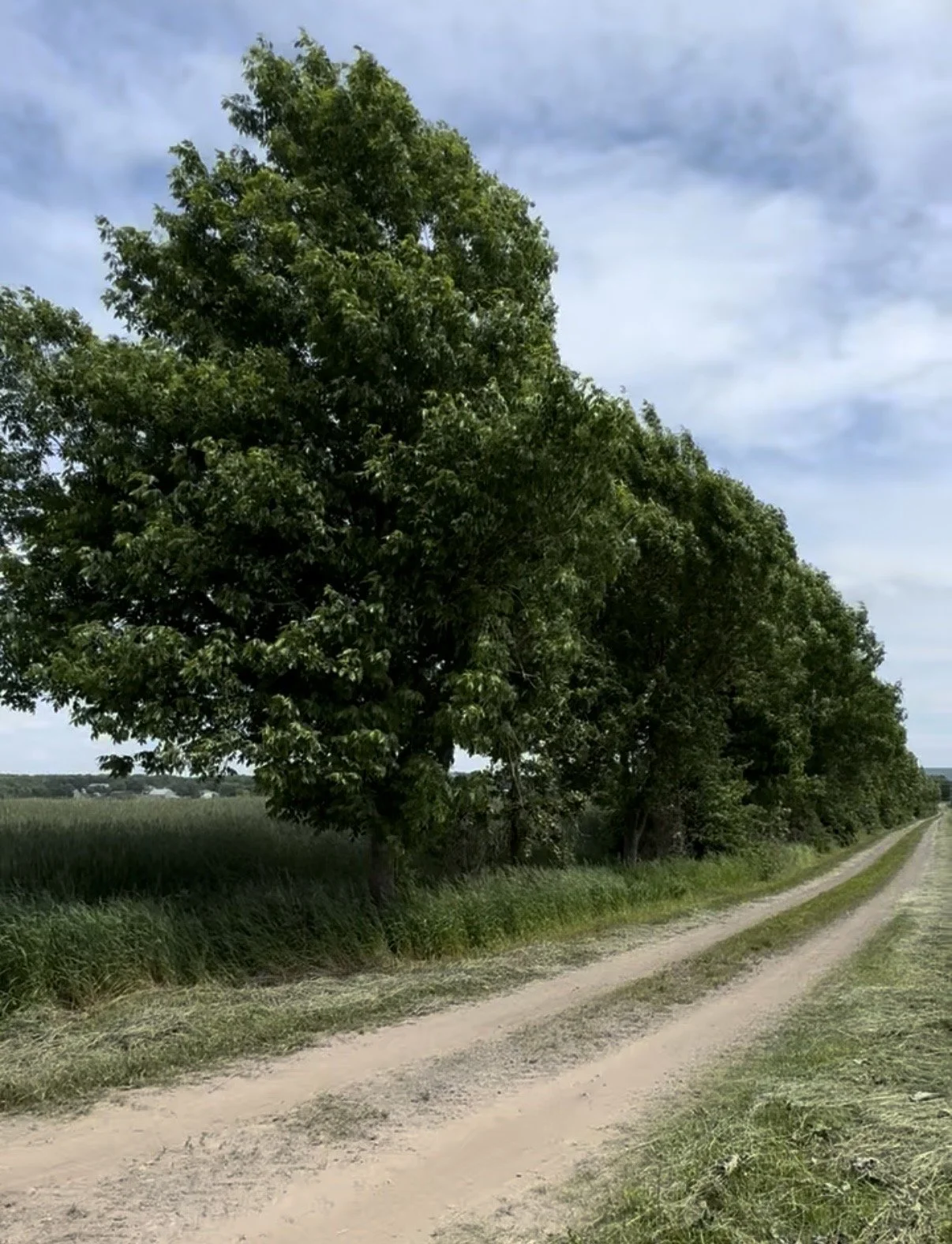
Reliable tree establishment systems for large-scale reforestation and agroforestry
Designed for sites where vegetation competition is high and maintenance access is limited.
Used in windbreak, reforestation, and field protection projects implemented within existing agricultural and environmental programs, including Prime-Vert, when project owners voluntarily choose a compostable alternative to polyethylene.
Why this application is different
Shelterbelts and reforestation projects often operate across large areas where vegetation competition is intense and maintenance access is limited.
Unlike managed orchard systems or landscaped sites, these projects must succeed with minimal intervention after planting. Once trees are established across long corridors, windbreaks, or restoration zones, repeated maintenance becomes costly and difficult to organize.
For this reason, long-term planting projects prioritize reliable vegetation control during the critical tree establishment phase, while minimizing the need for ongoing field intervention.
Where traditional solutions fall short
Several approaches are commonly used to reduce vegetation competition around young trees, including organic mulches, manual clearing, or polyethylene mulch systems.
Each option addresses part of the challenge, but limitations often appear at scale.
Polyethylene mulch can deliver reliable vegetation control, but it does not biodegrade and may fragment over time into persistent plastic residues in the soil.
In large-scale reforestation or agroforestry corridors, these limitations can translate into higher maintenance complexity and long-term environmental considerations.
How OrganicGUARD is used in this context
OrganicGUARD is installed at planting to provide reliable, low-maintenance vegetation control during the tree establishment phase.
The system functions as a base layer that stabilizes soil conditions around young trees while limiting vegetation competition during the years when trees are most vulnerable.
Once the establishment phase is complete, OrganicGUARD gradually breaks down through natural biological processes, leaving no permanent plastic infrastructure behind.
This approach allows projects to maintain the functional benefits of mulch systems while avoiding long-term plastic residues in forest soils.
Field installation considerations
Successful tree establishment depends not only on the mulch system itself, but also on proper installation conditions and appropriate equipment.
In large-scale planting projects, factors such as soil type, terrain conditions, planting methods, and operator experience can significantly influence final outcomes.
Roll-based installation systems typically require mechanized equipment capable of ensuring proper anchoring and soil contact. In heavier soils, such as clay, or in exposed environments, installation timing and field preparation become particularly important.
In situations where mechanized installation is not available, individual tree collars may represent a more appropriate solution.
OrganicGUARD is designed to support tree establishment during the critical early years, but successful planting ultimately depends on appropriate equipment, proper site preparation, and experienced operators.
A risk-based approach to mulch selection for linear and infrastructure projects
In windbreak, reforestation, and field protection projects, the objective is not to install a permanent material — it is to ensure successful tree establishment during a defined period.
These projects often extend across long corridors where vegetation competition is strong and maintenance access is limited. In this context, material selection must balance functional performance during the establishment phase with long-term environmental responsibility.
OrganicGUARD is designed around this principle: providing reliable vegetation control during the years when young trees are most vulnerable, while avoiding permanent plastic residues in the soil once its role is complete.
Why service life matters more than permanence
In many planting projects, the functional need for mulch systems is temporary.
The goal is to protect young trees during the critical establishment period, typically the first few growing seasons, when vegetation competition and environmental stress can significantly affect survival rates.
Installing materials that remain indefinitely in the soil may solve the short-term weed control challenge, but can introduce long-term environmental liabilities.
OrganicGUARD is therefore designed around functional service life, not permanent persistence.
Service life options are matched to project requirements:
3-year service life for shorter establishment cycles
5-year service life for more exposed or slower-growing planting systems
Once this functional period is complete, natural soil biological processes gradually break down the material and it is no longer required.
Performance versus long-term environmental risk
From a field performance standpoint, both polyethylene mulch and compostable mulch can provide effective vegetation control during the establishment phase.
The real difference lies in what remains in the soil afterward.
Polyethylene persists indefinitely and may fragment over time into microplastics, creating long-term plastic residues in the soil.
OrganicGUARD is designed so that natural biological processes gradually break down the material after its functional service life, leaving no permanent plastic infrastructure and no long-term plastic contamination in forest soils.
For linear infrastructure and low-access planting projects, this distinction can have significant implications for long-term environmental responsibility.
Regulatory and environmental context
Regulatory frameworks increasingly recognize the environmental risks associated with persistent plastic materials in natural and agricultural environments.
In Canada, for example, federal policies adopted under the Canadian Environmental Protection Act aim to reduce plastic pollution and address the long-term impacts of single-use plastics.
While agricultural and forestry applications are not always directly regulated, the regulatory direction is clear: materials that persist indefinitely in soil environments are increasingly viewed as environmental liabilities.
Selecting a compostable mulch system allows projects to align with evolving environmental expectations while maintaining the functional performance required for successful tree establishment.
Technical documentation for linear and infrastructure projects
For shelterbelt, reforestation, and field protection projects, technical documentation is often required to support internal reviews, environmental assessments, and project specifications.
To support this process, OrganicGUARD documentation includes:
Product technical specifications
Environmental material information
Service life options and recommended configurations
Installation guidance and end-of-life behaviour
These documents help project managers, agronomists, engineers, and procurement teams define performance requirements while avoiding long-term plastic residues in the soil.
▶ DOWNLOAD Product Data Sheet
▶ TÉLÉCHARGER la fiche technique
Includes material characteristics, service life options, installation guidance, and environmental specifications.
Installation & end-of-life guidelines
Proper installation is essential to ensure reliable field performance during the required service life.
The OrganicGUARD installation guide explains how to install the material efficiently in linear and low-access planting environments.
It also explains how the material behaves at the end of its service life and how natural soil biological processes gradually break down the material after its functional role is complete.
▶ DOWNLOAD the Installation Guide
▶ TÉLÉCHARGER le guide d’installation
Let’s discuss your project requirements and site conditions.