
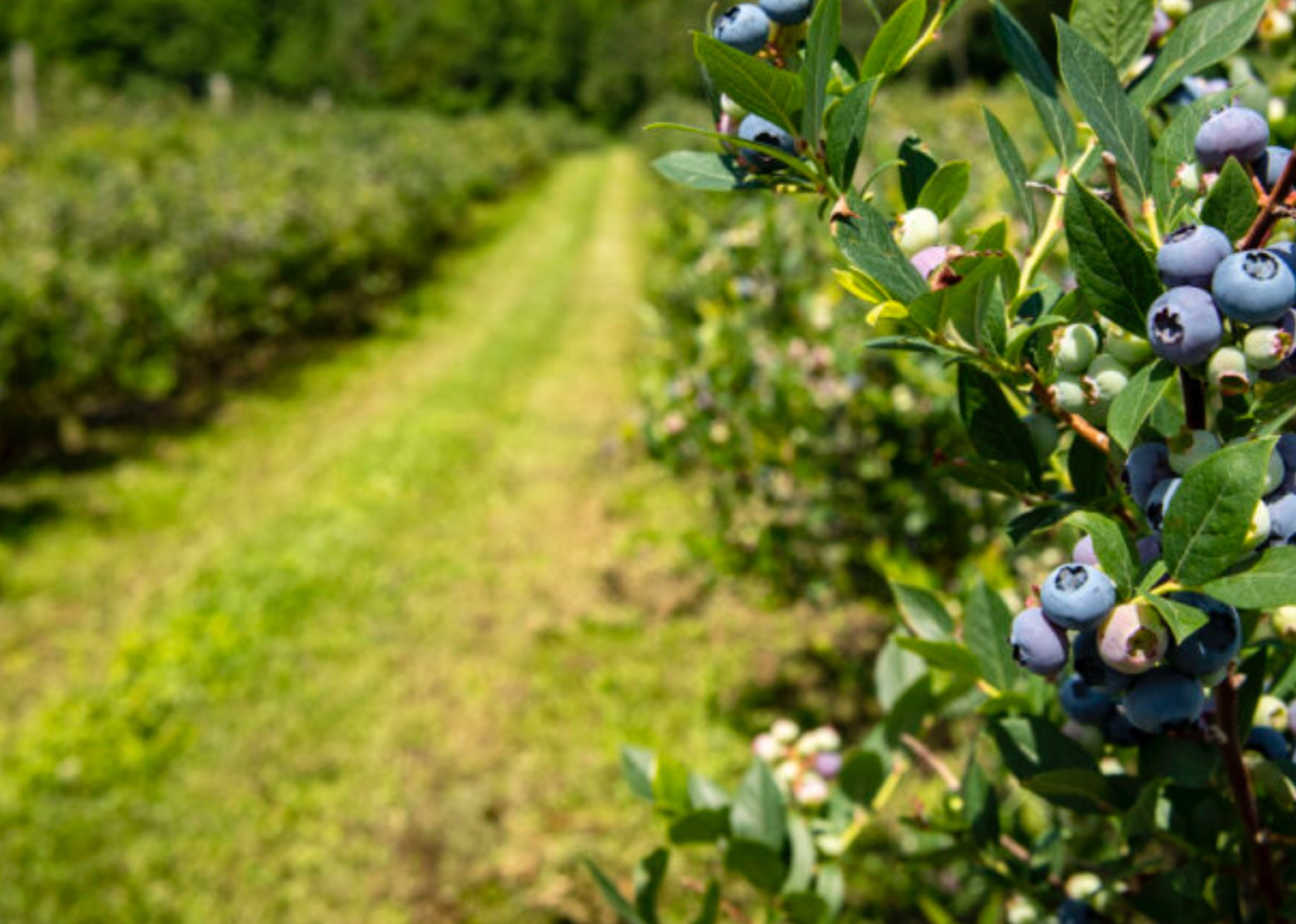
OrganicGUARD for Tree & Perennial Crop Establishment
Faster establishment and early growth, using compostable tree protection without polyethylene or plastic legacy.
Designed for orchards, nut trees, blueberries, perennial crops, maple groves, and long-term plantings where accelerated establishment, reduced inputs, and early performance pay.
Weed suppression without herbicides
Micro-climate that supports faster root development
Improved survival rates during the critical establishment phase
No plastic removal. No long-term soil liability.

A stable soil microclimate, the real advantage in perennial systems
In perennial crop establishment, the goal is not to heat or cool the soil aggressively, it is to temper extremes.
OrganicGUARD acts as a soil buffer:
In cooler conditions, it helps retain soil warmth and reduce heat loss.
In hot or humid conditions, it limits temperature spikes and preserves soil moisture by reducing surface evaporation.
The result is a more stable root environment, where moisture and temperature fluctuate less over time, exactly what young perennial root systems need during establishment.
This soil-level buffering effect is one of the key reasons OrganicGUARD performs so well in blueberries, orchards, vineyards, and other perennial systems
Reduced temperature swings at the root zone
Improved moisture retention during dry periods
Less stress during early establishment
More consistent root development year over year
Why this application is different
Establishing trees and perennial crops is a critical, irreversible phase.
The first years determine survival rate, root architecture, early growth, and long-term productivity.
Unlike annual crops, mistakes made during establishment cannot be corrected later.
Weed pressure, moisture stress, and soil temperature fluctuations during this phase directly impact the lifespan and performance of the planting.
Where traditional solutions fall short
Repeated weed competition during the first growing seasons
High labor and maintenance costs with organic mulches
Plastic mulch removal after establishment
Long-term soil contamination from polyethylene fragmentation
Inconsistent performance across different soil types and climates
In perennial systems, short-term fixes often create long-term liabilities.
How OrganicGUARD is used in this context
OrganicGUARD is installed at planting to create a stable, weed-free micro-environment during the establishment phase.
Suppresses weeds without herbicides
Moderates soil temperature and moisture at the root zone
Reduces early-season stress and competition
Supports faster root development and uniform early growth
The result is a stronger, more resilient planting from year one.
What happens over time
OrganicGUARD is designed to remain functional throughout the establishment phase, then gradually transition through natural biological processes.
No plastic removal at the end of use
No fragmentation into microplastics
No long-term plastic or environmental liability
Over time, the material is transformed by natural biological processes, leaving no persistent plastic residue.
Typical projects we see
Orchard establishment (apple, pear, cherry, nut trees)
Blueberry and small fruit perennial systems
Vineyards and specialty perennial crops
Maple groves and agroforestry plantings
Long-term experimental or research plots
If early establishment matters, this application fits.
-
Yes. OrganicGUARD is designed specifically for the establishment phase of perennial crops, where weed control, soil moisture conservation, and soil protection are critical during the first years.
It is used successfully in a wide range of perennial systems, including blueberries, raspberries, strawberries, orchards (apple, pear, cherry), nut trees (hazelnut, walnut, chestnut), vineyards, maple groves, agroforestry plantings, and other perennial crops where repeated soil disturbance is not desirable.
-
Yes. This is a common concern, and largely a myth.
OrganicGUARD is not porous, but water reaches the root zone naturally through:
rainfall flowing down leaves and stems toward the trunk or crown
irrigation systems, when used, depending on the crop and production system
lateral soil moisture movement beneath the mulch
This solution is compatible with drip irrigation when applicable, and fertigation remains optional depending on crop requirements and grower practices. The mulch reduces surface evaporation and helps preserve soil moisture.
If roots ever require additional water, they will naturally grow toward available moisture. In practice, water stress caused by mulch is extremely rare when rainfall or irrigation is properly managed.
-
Yes, and this is an important clarification.
Roots develop in the soil, not in the mulch. With a 1 m × 1 m mulch installed and the plant positioned at the center, roots are protected over a 50 cm radius while growing downward and outward beneath the mulch layer.
By preserving soil moisture and moderating soil temperature, OrganicGUARD creates a more stable soil microclimate. This reduces stress on young plants and often results in faster, more uniform root development during establishment.
Roots naturally follow moisture and nutrient gradients in the soil profile. The mulch protects the soil surface while supporting normal — and often accelerated — root growth beneath it.
-
OrganicGUARD is available in two service lifespans:
3 years
5 years
The correct choice depends on crop type, weed pressure, climate, and how long weed control is required during establishment.
-
Once its service life is reached, OrganicGUARD gradually loses its mechanical function at the soil surface.
From that point on, biodegradation continues over time through natural biological activity.. The rate of this process varies depending on climate, biological conditions, moisture, and microbial activity.
In perennial crop systems where the objective is to maintain a functional mulch for up to 5 years, complete biodegradation typically occurs over an additional 7 to 10 years.
Over time, the material is transformed through natural biological processes into water, CO₂, and biomass, without requiring removal and without leaving plastic or microplastic residues behind.
-
No.
OrganicGUARD does not contain polyethylene and does not generate microplastics.
While polyethylene mulch gradually fragments into persistent microplastics that can remain in soils for decades, OrganicGUARD breaks down through microbial biodegradation and is metabolized by soil microorganisms.
Over time, the material is biologically converted into:
water
CO₂
biomass
No plastic residue remains.
-
The ability to maintain a functional mulch membrane for up to 5 years is proven.
The real question is not whether the material works, but whether this system is compatible with your specific growing conditions and objectives.
The recommended approach is to test the solution on a limited area before large-scale deployment, then scale once performance is validated under real field conditions.
-
Before selecting a long-term mulch system for perennial crops, it’s important to consider:
crop type and planting density
local climate and temperature extremes
expected duration of weed control during establishment
natural rainfall patterns and/or irrigation practices
soil biology, organic matter, and drainage conditions
Choosing the correct service life, and installing the product properly, are key to long-term performance.
Every farm is different. That’s why we’re always available to discuss your specific conditions and help determine whether this solution is the right fit for your system.
Learn more (optional details)
Available formats & service life
OrganicGUARD is available in two proven service lives, 3 years or 5 years, and in two installation formats, depending on your project type, equipment, and planting layout.
Roll format (mechanized installation)
48 inches × 1,000 ft rolls
Installed using a mulch layer
Sold by the roll or by pallet (25 rolls)
This format is well suited for perennial plantings where mechanized installation is preferred.
If needed, we can help identify mulch layer equipment available near your location or provide guidance on installation options.
Collar format (manual installation)
3-year collars
60 cm × 60 cm
20 cm center slit
Sold in boxes of 250 collars
5-year collars
1 m × 1 m
Slit extending from the center to one side
Sold in boxes of 90 collars
Collars are ideal for orchards, nut trees, agroforestry, and targeted perennial plantings where individual plant protection is preferred.
Installation note
The number of anchoring pins required depends on soil conditions and installation method.
Please refer to the Installation Guide below for detailed recommendations.