
Can Microplastics Interact With Crop Roots?
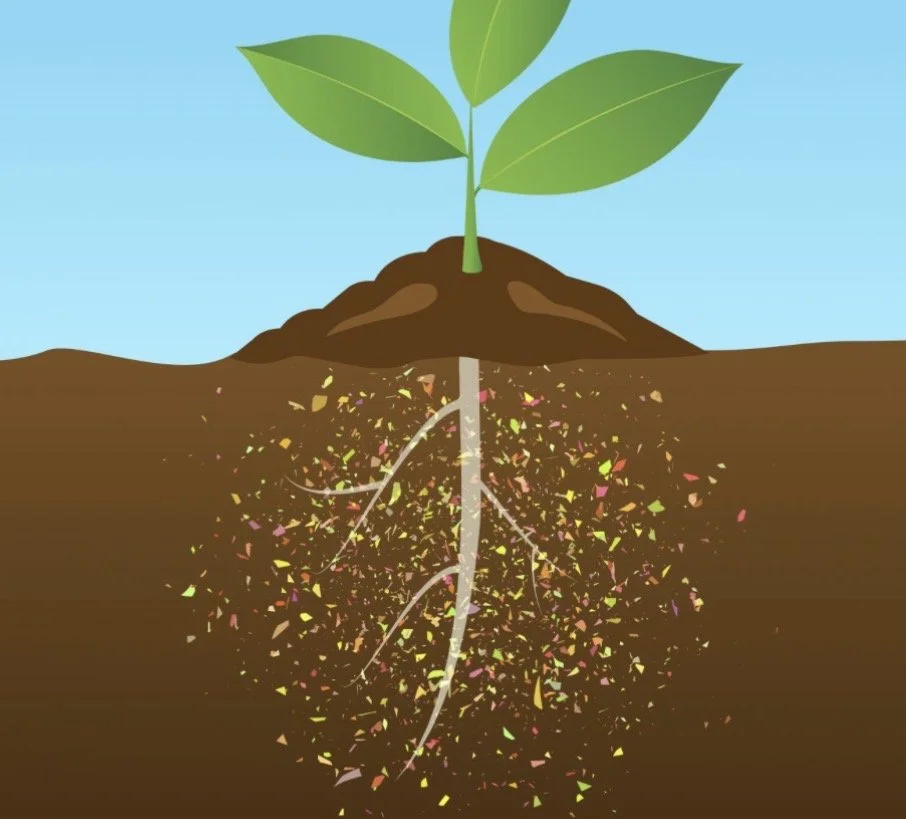
Understanding Plastic Fragmentation in Agricultural Soil
Interest in microplastics in agriculture is relatively recent.
For decades, plastic use in farming was evaluated mainly through practical criteria: durability, cost, and ease of handling.
The broader scientific concern around microplastics first emerged in marine research in the early 2000s. Oceans and freshwater systems were the initial focus.
Only later did researchers begin asking a different question:
What happens when plastic fragments accumulate in soil?
Agricultural soils are intensively managed. They are tilled, irrigated, fertilized, and biologically active. They also receive repeated applications of plastic materials — particularly mulch films.
By the 2010s, researchers began documenting:
Residual plastic fragments in cultivated soils
Progressive fragmentation across multiple growing seasons
Formation of microplastics within agricultural fields
In 2021, the Food and Agriculture Organization of the United Nations (FAO) released a global assessment identifying agricultural soils as a significant and under-studied reservoir of plastic accumulation.
The conversation has since evolved.
The question is no longer whether plastics fragment in soil.
They do.
The emerging scientific question is more specific:
As plastics fragment into micro- and nano-scale particles, can those particles interact with living soil systems — including crop roots?
Soil microplastics are now considered an emerging research field — not a fringe theory.
To understand that discussion, we must first understand scale.
A. Plastic Particles by Size: From Macro to Nano
Plastic in soil does not vanish.
It changes scale.
As materials fragment under UV exposure, mechanical stress, soil movement, and weathering, they move through several size categories. Scientists classify these categories because environmental and biological behavior changes significantly as particles become smaller.
Macroplastics
Macroplastics are fragments larger than 5 millimeters (mm).
These include visible pieces of torn mulch film or plastic residues left in soil.
They are large enough to see and physically remove.
At this stage, contamination is visible.
Mesoplastics
Mesoplastics range from 5 mm down to 1 mm.
These fragments are often produced by UV exposure, mechanical stress, and tillage.
They may still be visible, but they increasingly mix into soil aggregates and become harder to extract.
Microplastics
Microplastics are defined as particles smaller than 5 mm and down to 1 micrometer (µm).
To understand the scale:
A human hair is approximately 70 micrometers (µm) thick.
Some microplastics are already smaller than the thickness of a hair.
At this scale:
They are not easily visible in soil
They mix thoroughly with soil particles
They may move with soil water
They are no longer simple surface debris
Microplastics represent a shift from visible contamination to microscopic dispersion within the root zone.
Nanoplastics
Nanoplastics are particles smaller than 1 micrometer (1 µm), often measured in nanometers (nm).
For perspective:
1 micrometer equals 1,000 nanometers.
Nanoplastics can be hundreds of times smaller than the width of a human hair.
At this scale, particles approach the size range of bacteria and cellular structures.
Why Size Changes the Discussion
As particle size decreases:
Surface area increases relative to volume
Mobility in soil water increases
Interaction with microorganisms becomes more plausible
Physical separation from biological systems becomes less absolute
Large plastic fragments are primarily physical contaminants.
Micro- and nano-sized particles are biologically relevant.
Fragmentation is not simply plastic “breaking apart.”
It is a transformation from visible debris into microscopic material capable of interacting with soil systems.
Size matters.
B. Soil Is a Living System
Agricultural soil is not inert.
It is:
Biologically active
Mechanically disturbed
Moisture-variable
Microbially complex
Plastic particles that remain in soil are continuously exposed to biological processes.
The FAO’s 2021 global assessment on agricultural plastics highlights fragmentation and microplastic accumulation as growing concerns in agricultural systems.
As fragmentation continues over time, particle size decreases.
Smaller particles increase the potential for interaction with plant roots and soil organisms.
C. Can Particles Interact With Roots?
Scientific research in controlled environments has shown that very small plastic particles — particularly in the nano-scale range — can adhere to root surfaces.
Some studies suggest limited movement within plant tissues when particle size is sufficiently small.
Field conditions are more complex than laboratory systems.
But the biological pathway becomes more plausible as particle size decreases.
The principle is straightforward:
As plastics fragment, they do not disappear — they become smaller.
D. Accumulation Is Cumulative
Agricultural fields are reused year after year.
If plastic residues fragment and remain in soil:
Particle concentration may increase over time
Each season adds additional material
Removal becomes impossible at microscopic scale
Once plastic particles reach micro- or nano-size, recovery is no longer realistic.
The meaningful control point is material design before field application.
E. Two Different Soil Trajectories
There are fundamentally different outcomes for materials used in soil.
One pathway leads to fragmentation and persistence.
The other leads to biodegradation through microbial activity, converting material into carbon dioxide, water, and biomass.
These are not equivalent outcomes.
They are not equivalent chemistry.
And they are not equivalent long-term soil scenarios.
Source
Food and Agriculture Organization of the United Nations (FAO). 2021.
Assessment of Agricultural Plastics and Their Sustainability: A Call for Action.
Rome: FAO.
Full report (PDF):
https://www.fao.org/3/cb7856en/cb7856en.pdf
Continue the Soil Conversation
👉 Understand how true soil-biodegradable mulch differs from fragmentation-based plastics.
https://filmorganic.com/insights/fragmentation-vs-biodegradation