
What Controls Mulch Durability in the Field?
Compostable mulch performance is not determined by thickness alone.
In real agricultural conditions, durability is controlled by a combination of formulation, stabilization, UV exposure, soil temperature, and crop timing.
Field performance is engineered — not assumed.
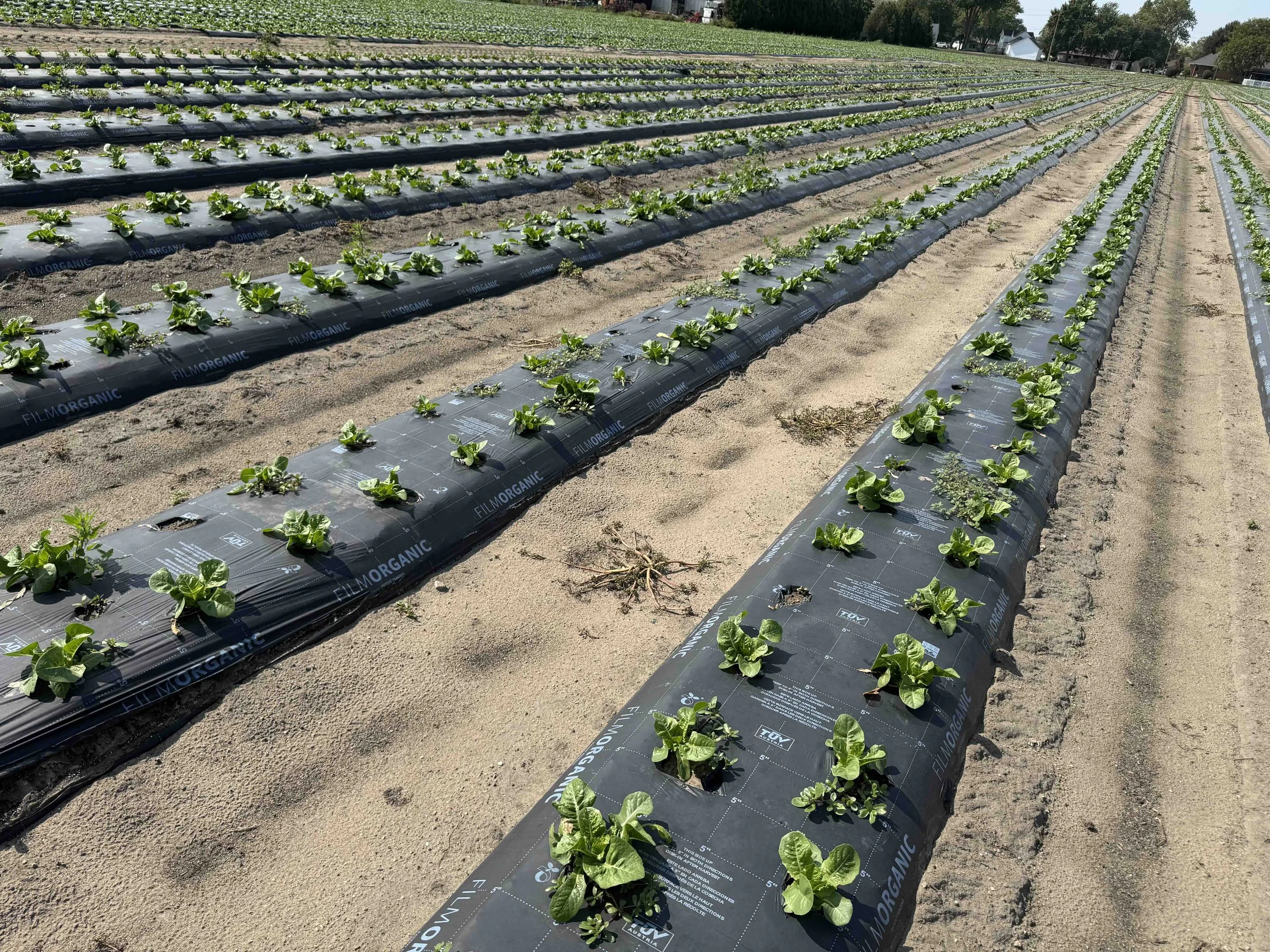
One installation. Two crops. Same film.
Installed in April.
Still performing in September.
This is what engineered durability looks like in the field.
1. UV Exposure Is the Primary Stress Factor
Sunlight is the most aggressive force acting on mulch during the growing season.
Ultraviolet radiation initiates surface degradation and progressively reduces tensile strength if the film is not properly stabilized.
Crop architecture plays a decisive role:
Melons and squash provide rapid canopy shading.
Tomatoes offer partial coverage — but row edges often remain exposed.
Peppers leave mulch edges exposed for most of the season.
Early-season systems may leave film fully exposed for weeks.
Edges matter.
Full-season edge exposure is often where premature failure begins.
UV stabilization must therefore be designed according to crop structure and exposure duration — not just calendar length.
2. Formulation, Coating, and Stabilization Matter More Than Thickness
A common misconception is:
“Thicker film = longer durability.”
In compostable systems, this is incomplete.
Durability is primarily influenced by:
Polymer matrix design
Stabilization package
Resistance to UV oxidation
Controlled hydrolysis behavior
Surface coatings in some systems
Coatings can significantly improve surface stability and delay premature degradation under UV stress and moisture exposure.
Thickness can add mechanical strength.
But thickness does not compensate for poor formulation.
A thick film built on unstable chemistry will still fail.
3. Why Some “Short Compostable” Films Fail Early
Many short-life compostable films on the market rely heavily on starch-based formulations.
High starch content can reduce cost and accelerate disintegration.
But it also increases sensitivity to:
UV exposure
Rain and prolonged moisture
Soil microbial activity
Under dry conditions, these systems may appear acceptable.
Under a wet season, the reality becomes clear.
Extended rainfall accelerates loss of mechanical integrity.
Edge failure begins.
Tearing increases.
Anchoring weakens.
It often takes one rainy season to understand why engineered systems exist.
Not all compostable mulch is built for agricultural durability.
Conclusion
Field durability is not accidental.
It is the result of:
Controlled formulation
Proper stabilization
Crop-aligned design
Surface protection strategy
A mulch system must remain stable during use and begin biodegradation only after incorporation.
Mulch should match the crop cycle — and withstand real weather.
That is field performance.