
What Happens to Plastic Mulch After Harvest?
Plastic doesn’t disappear.
It changes form.
And that difference matters.
1. Removal Is Never 100%
When polyethylene mulch is removed, what you see is not the full story.
Even with careful lifting:
Torn edges remain buried
Thin strips shear off during pulling
Small pieces stay wrapped around roots
UV-weakened sections fragment under tension
What gets loaded into a trailer is the visible plastic.
What stays behind is the beginning of soil contamination.
And oxo-degradable films?
They accelerate fragmentation — they don’t solve it.
Fragmentation is not biodegradation. It is just smaller plastic.
2. Break Up vs Break Down
Conventional Polyethylene
Breaks up into fragments
Leaves microplastics
Persists for decades
Requires removal
Compostable Bioplastics
Breaks down into water, CO₂ and biomass
Leaves no microplastics
Fully metabolized by microbes
Incorporated into soil
Polyethylene is not biodegradable.
It fragments into microplastics that remain in the soil profile.
Compostable mulch is designed to be consumed by soil microorganisms after its functional life.
That is not marketing language — that is chemistry.
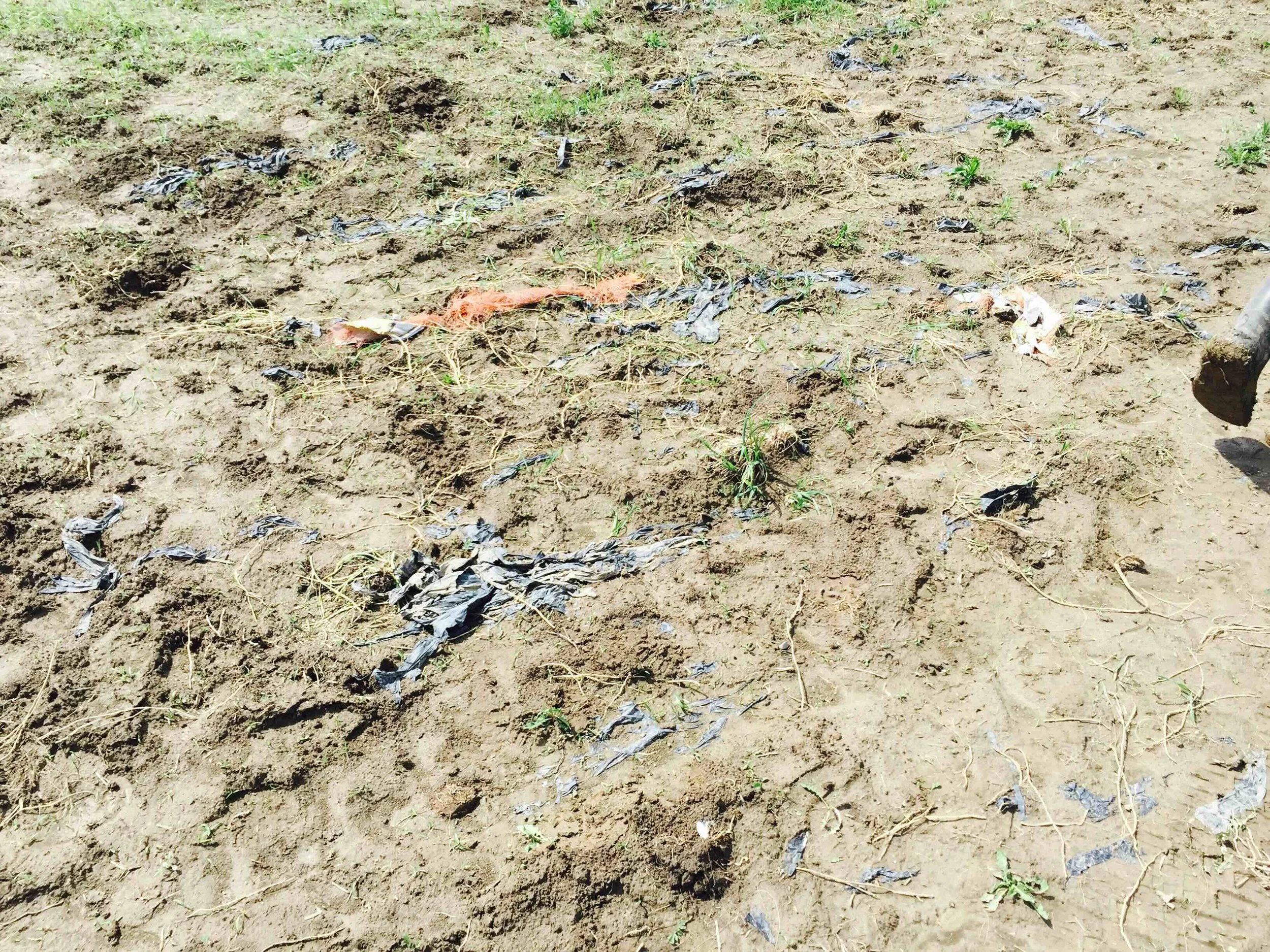
Plastic mulch fragments remaining in the field after removal — small pieces that stay behind season after season.
3. Microplastics and Soil Health
Soil is not dirt.
It is a living biological system.
Microplastics have been shown to:
Alter soil aggregation
Disrupt microbial balance
Interfere with water retention
Persist in root zones
Long-term accumulation is the real issue.
Not one season — ten seasons.
Especially in high-value crops like vegetables and berries where plastic is used year after year.
4. The Organic Paradox
Organic growers work incredibly hard to protect:
Soil biology
Regenerative systems
Carbon sequestration
Reduced chemical inputs
But here’s the uncomfortable reality.
In North America, regulatory frameworks often focus on where a material comes from, not what it leaves behind.
If a mulch film is not 100% bio-based — even if it fully biodegrades in soil and leaves no trace — it may not qualify for use in certified organic production.
So what happens instead?
Growers are required to use polyethylene mulch.
A material made from fossil resources.
A material that does not biodegrade.
A material that must be removed from the field.
And a material that inevitably fragments over time, leaving microplastic residues in the soil.
Let that sink in.
A biodegradable mulch that disappears without residue may be restricted.
A fossil-based plastic that fragments into microplastics is permitted — as long as it is removed.
To the public, “organic” means healthier food, cleaner soil, and better environmental stewardship.
But when end-of-life impact is ignored, the system creates a contradiction:
We protect inputs.
We overlook residues.
If soil is the foundation of organic agriculture, then what remains in that soil matters more than the label of the raw material.
And this conversation is only just beginning.
5. A Different Design Philosophy
Compostable mulch is engineered with two objectives:
Controlled durability during the crop cycle
Biodegradation in soil after use
Durability first.
Biodegradation second.
Not fragmentation.
That distinction changes everything.
Final Thought
Plastic mulch removal solves a visible problem.
Biodegradation solves an invisible one.
And in agriculture, invisible problems are usually the ones that cost the most over time.