
Garlic Under Controlled Dormancy
The FilmOrganic Approach to Winter Soil Stability and Spring Yield Acceleration
Garlic is planted in fall.
Harvested in July.
That means:
Long dormancy (November–March)
Spring weed explosion
High manual labor
Yield variability driven by bulb sizing
Most systems treat garlic like a spring crop.
It is not.
Garlic is a winter stability crop.
And that changes everything.
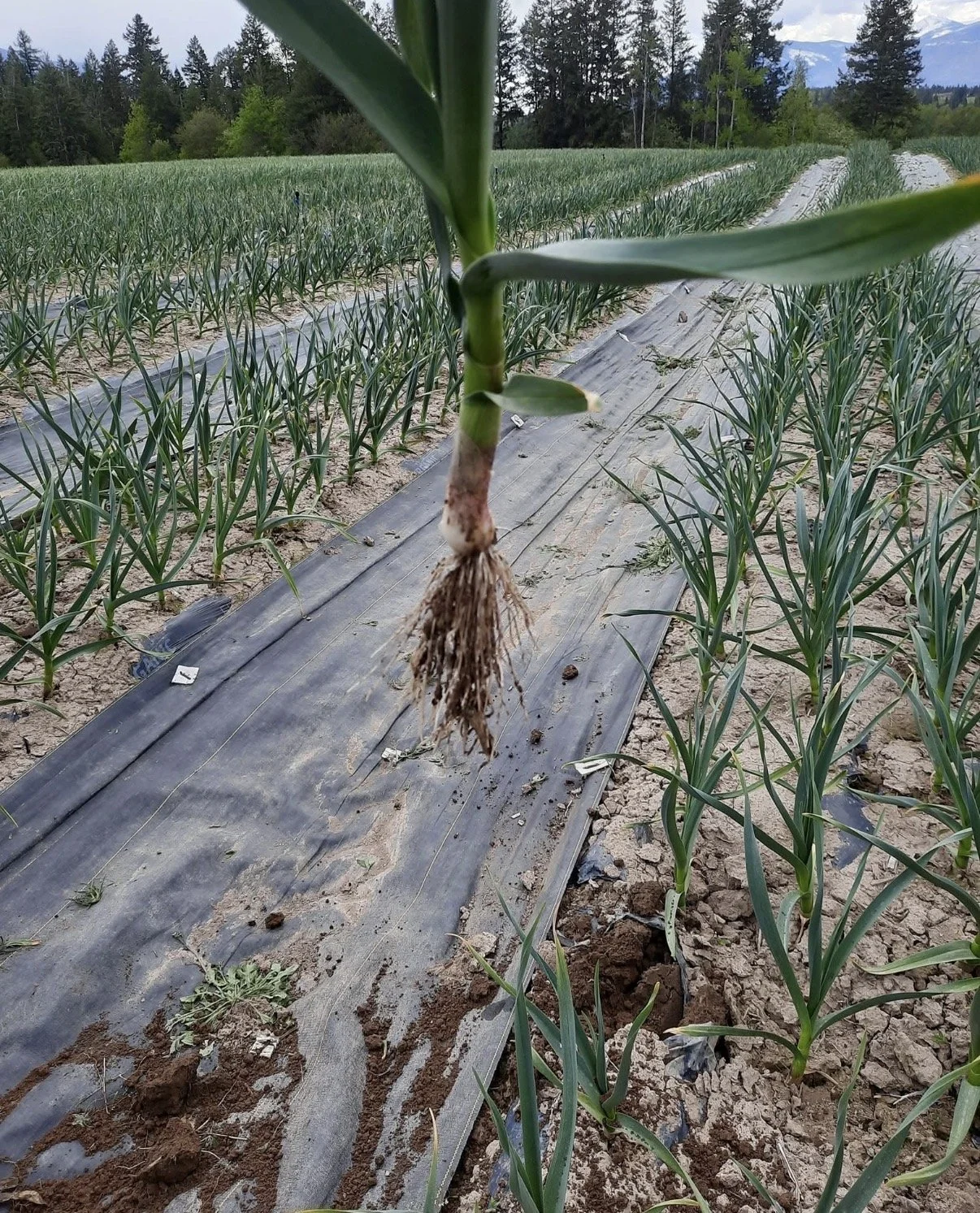
FilmOrganic Black #36 under 1–2 inches of soil cover.
The surface fabric controls inter-row weeds.
The FilmOrganic mulch remains below the soil line — protecting winter dormancy, preserving moisture, and allowing garlic to emerge through a weed-free, stabilized bed in spring.
A. Autumn Installation — Immediate Microclimate Control
When FilmOrganic is installed in fall and lightly covered with 1–2 inches of soil or straw:
Soil moisture is preserved immediately
Temperature fluctuation is reduced
Root establishment improves before winter
Surface erosion is minimized
You are not waiting for spring.
You are stabilizing the field before dormancy even begins.
This controlled soil environment allows garlic to enter winter already structured — not exposed.
B. Dormancy Protection (November–March)
During dormancy:
Soil experiences freeze–thaw cycles
Surface crusting can occur
Nutrient mobility fluctuates
FilmOrganic acts as a stabilizing membrane:
Moisture retention remains consistent
Soil temperature is buffered
Early root systems are protected
Soil structure remains intact
Dormancy becomes controlled — not disruptive.
This is where uniformity begins.
C. Spring Weed Pressure — Already Handled
The real weed pressure in garlic comes in spring.
Spring weeds are aggressive.
They are labor-intensive.
They cost time and money.
Because FilmOrganic was installed in fall:
The soil surface is already protected
Weed emergence is blocked from day one
There is no reactive weeding cycle
You are not chasing weeds.
You are ahead of them.
Avoiding spring weed establishment can save significant labor — often 2–3 weeks over the season.
That alone shifts the economics of garlic production.
D. Spring Acceleration — Root System Already Established
When soil warms in spring:
Roots are already developed
Microbial activity is already structured
Nutrient uptake begins immediately
Growth accelerates uniformly
The crop does not “catch up.”
It moves forward.
The result:
More uniform stands
More uniform bulb sizing
Higher head count
Larger bulbs
And in garlic, size drives value.
Bigger bulbs command higher price per pound.
E. Harvest — No Plastic Removal. No Residue. No Microplastics.
At harvest:
There is no plastic to remove.
FilmOrganic is designed to:
Maintain durability through dormancy
Remain stable through spring development
Begin biodegrading naturally before or around harvest
Polyethylene does not biodegrade.
It fragments and leaves microplastics in soil.
FilmOrganic transitions biologically — without persistent synthetic residue.
Clean harvest.
Clean soil.
No plastic legacy.
What This Means for Garlic Growers
Higher yield per acre
Larger, more uniform bulb sizing
Higher selling price per pound
Significant reduction in seasonal labor
No disposal logistics
No soil contamination from microplastics
This is not just weed suppression.
It is yield engineering.
It is soil protection.
It is margin protection.
Built During Dormancy. Sold at Harvest.
Garlic performance is determined months before lifting bulbs.
Match the right durability class to your:
Bed height
Climate
Irrigation pattern
Expected July harvest window