
Strawberries: If It Can’t Survive Solanaceae, It Won’t Survive Strawberries
Most short-cycle compostable mulch films fail first in tomatoes — or any Solanaceae crop.
Tomatoes, peppers, eggplant — these crops expose formulation weaknesses quickly.
If a film becomes brittle in a Solanaceae system, strawberries will magnify the failure.
Strawberries are not forgiving.
Solanaceae Are the Warm-Up
Tomatoes already expose the main durability stress factors:
High soil heat combined with moisture at the bed interface
Full UV exposure from direct sunlight
Exposed bed shoulders with no early canopy protection
Mechanical stress from installation, wind, and field traffic
Unlike melon systems, there is no early canopy to shield the mulch.
The shoulders of the bed remain fully exposed to UV radiation for weeks.
If a film begins to embrittle, lose flexibility, or weaken under these conditions, strawberries — with their longer field duration — will accelerate the failure.
The Thick Film Trap: Why 1.0 mil Isn’t the Solution
Some growers tried thicker starch-heavy films — even 1.0 mil — assuming thickness equals durability.
It does not.
When moisture penetrates a poorly balanced biodegradable matrix, especially starch-dominant formulations, structural integrity declines:
Water absorption
Loss of internal cohesion
Progressive embrittlement
Premature tearing under stress
The issue is not thickness.
Durability is controlled by:
Selecting the right biodegradable components
Proper UV stabilization
Matrix balance between flexibility and strength
Surface coatings when required
Gauge alone cannot fix poor formulation.
Related Article
What Actually Controls Durability (It’s Not Thickness) →
Strawberries Are Not One System — They Are Three
1. Matted Row (Northern Systems)
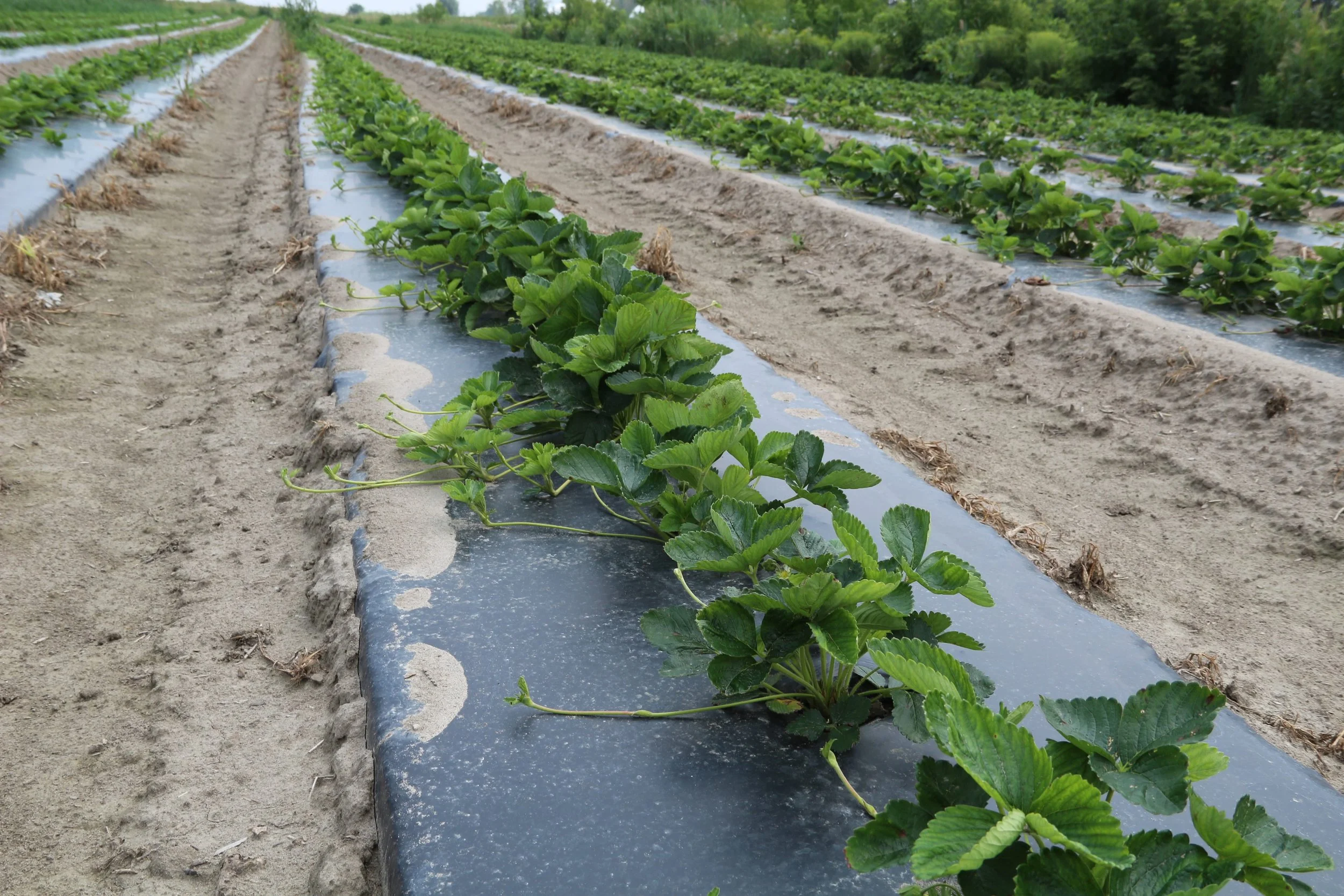
FilmOrganic Black #36 installed in a northern matted row strawberry system.
FilmOrganic mulch is placed at establishment, allowing mother plants to develop in a weed-free environment from day one. By suppressing early competition, FilmOrganic reduces hand-weeding labor and improves nutrient availability for uniform crown development. At the end of the cycle, FilmOrganic compostable mulch is incorporated directly into the soil — no plastic removal, no disposal logistics.
The Most Logical Application for Compostable Mulch
Matted row strawberries were historically grown without plastic.
Which meant:
Early-season weed competition
Repeated hand-weeding
Nutrient competition
High labor pressure
Installing compostable mulch at establishment transforms the system.
Mother plants are set directly through the compostable film.
From day one:
Weed emergence is suppressed
No early flush of competition
Reduced need for repeated hand-weeding
More uniform crown establishment
If weeds never establish early, they do not dominate later.
That creates:
Significant labor savings
Improved nutrient availability for strawberry plants
Faster root establishment
Better field uniformity
This is how you maximize a historically mulch-free system.
And at the end of the cycle?
No plastic removal.
No disposal cost.
No fragments left in the field.
Incorporate and move forward.
For northern growers managing labor constraints, matted row combined with compostable mulch is a structural efficiency improvement.
2. Annual Plasticulture (Spring Plant → Fall Harvest)
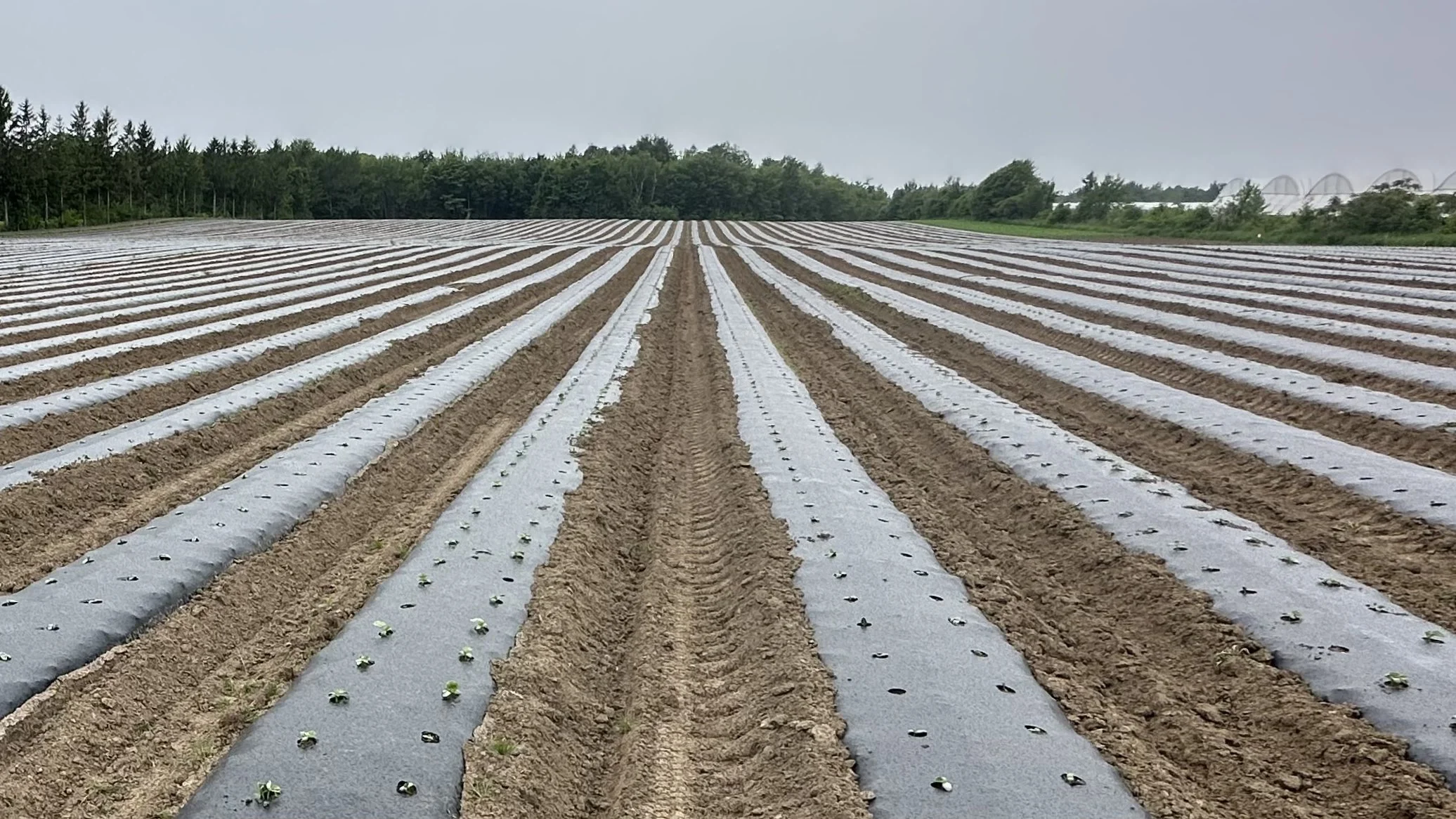
Annual strawberry plasticulture using FilmOrganic Black #66.
Engineered for peak summer UV exposure and exposed bed shoulders, FilmOrganic maintains structural integrity through the full harvest window. Designed for 5–7 month field duration, FilmOrganic Black #66 delivers consistent weed suppression without premature embrittlement. After harvest, FilmOrganic compostable mulch eliminates the need for plastic removal, saving labor and preserving soil integrity.
Day-neutral or annual systems require:
Stability through peak summer UV
Resistance to exposed bed shoulders
Consistent weed suppression until final pick
Early in the season, there is limited canopy protection.
The mulch absorbs full UV stress.
If stabilization is insufficient, embrittlement develops.
Durability must match the real exposure window — not a theoretical lifespan.
3. Winter-Over Systems
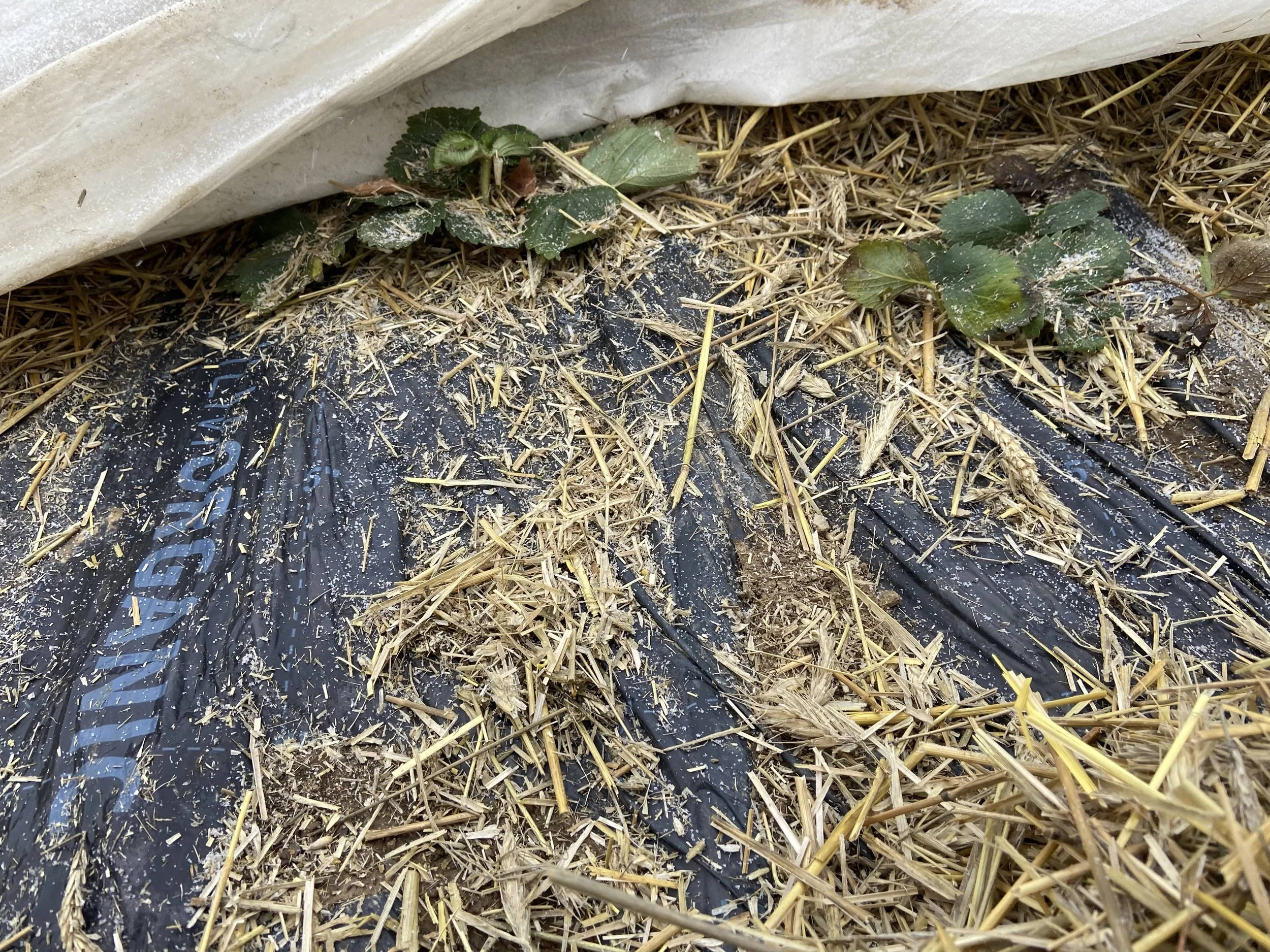
Winter-over strawberry production with FilmOrganic Black #88.
Specifically engineered for long-cycle durability, FilmOrganic Black #88 supports late summer or early spring planting systems exposed to extended UV, moisture, and freeze–thaw cycles. When used with row cover protection, FilmOrganic maintains flexibility and performance throughout dormancy and spring harvest. At incorporation, FilmOrganic biodegrades in soil — no retrieval, no landfill, no residual plastic.
(Late Summer or Early Spring Planting → Spring Harvest)
This is the endurance test.
Whether planted in late summer or in early spring (April) for extended harvest cycles, these systems expose mulch to prolonged environmental stress:
Extended UV exposure
Exposed shoulders before canopy closure
Freeze–thaw cycles
Moisture saturation
Wind stress in early spring
The mulch remains in the field far longer than short-cycle vegetable systems.
In winter-over production, a row cover is essential.
Row covers:
Reduce direct UV load
Protect plants during dormancy
Limit extreme winter exposure
Without row cover protection, no mulch system will perform optimally over extended winter cycles.
Durability in winter-over strawberries must be intentionally engineered for long exposure timelines and used within a complete agronomic system.
This is not short-cycle production.
It requires long-cycle engineering.
What Proper Performance Looks Like
A strawberry-ready compostable mulch film must:
Maintain flexibility under prolonged UV exposure
Resist progressive embrittlement
Stay intact on exposed bed shoulders
Suppress weeds from establishment
Break down only after incorporation into soil
Controlled field performance.
Not thickness.
Not assumptions.