
WHAT ACTUALLY CONTROLS DURABILITY
(It’s Not Thickness)
Durability in compostable mulch is only marginally influenced by thickness.
In certain formulations — particularly in the category of short-cycle compostable films — thickness has very little impact on real field longevity.
Why?
Because when moisture penetrates a moisture-sensitive matrix, the material begins to behave like a sponge.
Water moves through it.
Microbial activity increases internally.
Structural cohesion weakens from the inside out.
Under those conditions, increasing mil thickness does not fundamentally solve the problem.
This is especially true in short-cycle compostable systems, which are intentionally engineered to biodegrade quickly and often rely on moisture-sensitive components to trigger breakdown.
When exposed to sustained rainfall, prolonged soil saturation, or high microbial pressure, the internal matrix can weaken rapidly — regardless of thickness.
Adding more mils in that context simply adds more material to a moisture-vulnerable structure.
It does not change how the material behaves once water penetrates and biological activity begins from within.
Thickness becomes a secondary factor.
Structural design remains the primary one.
Durability is not controlled by mil count.
It is controlled by engineering.
In agriculture, we do not design for perfect seasons.
We design for heavy rain, strong UV, heat waves, and biological pressure.
FilmOrganic durability is built on two distinct technological advantages.
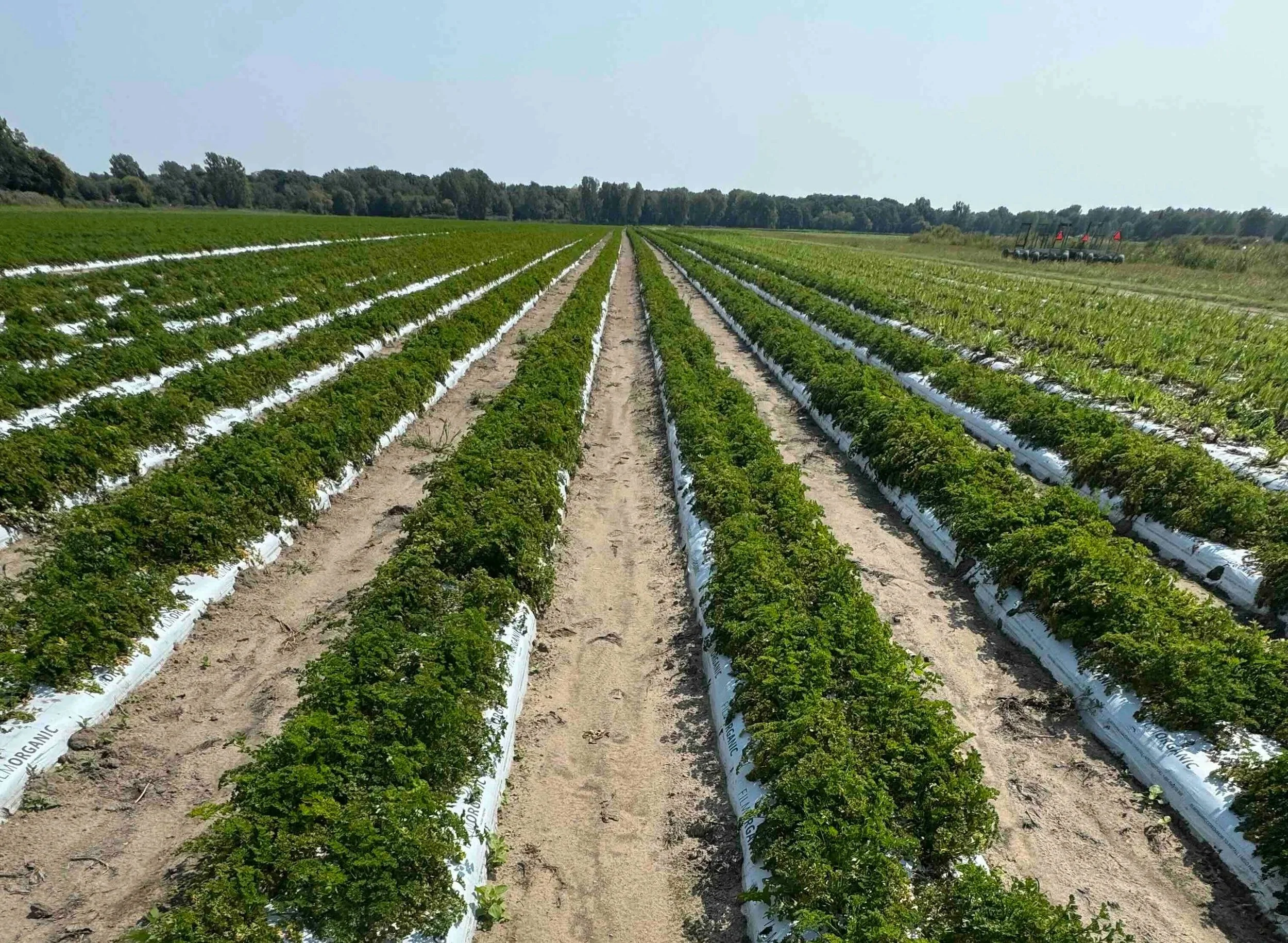
CoolWhite #66 after six months of full exposure. Still performing. Engineered durability in real field conditions.
A — Structural Formulation
(Certified Compostable, Engineered for Stability)
The real challenge in compostable mulch is this:
We are building a system designed to disappear.
Every ingredient must be certified compostable.
Every component must ultimately biodegrade in soil.
That means we are not working with inert plastic.
We are working with material intentionally designed to return to biology.
The engineering challenge is simple to describe — but difficult to execute:
Build a system that lasts as long as possible, knowing it is designed to biodegrade.
It is like building a house with a deck of cards.
With the right structural balance, it stands.
With the wrong balance, it collapses.
Some compostable films on the market include high starch content to reduce raw material cost.
Starch is biodegradable — but it is highly moisture-sensitive.
Under wet field conditions, starch absorbs water.
As it begins to break down, it can create micro-voids within the structure.
Instead of remaining dense and stable, the material behaves more like a sponge.
And in agriculture, sponge-like materials do not survive rainy seasons.

Starch-based compostable film after 4 months during a rainy season — visible surface weakening and early structural fatigue.
FilmOrganic formulations are engineered without starch fillers.
All ingredients used are certified compostable,
but we work with more structurally stable biopolymers designed to maintain mechanical integrity under field stress.
Water penetration is controlled.
Structural cohesion is preserved.
Mechanical strength remains stable throughout the crop cycle.
The goal is not simply biodegradability.
The goal is controlled biodegradability.
Avoid the sponge.
Engineer the structure.
B — Advanced Surface Protection
(Protective Coating Technology)
UV exposure is the primary stress factor above ground.
Sunlight attacks the surface first.
Once the surface weakens, structural breakdown accelerates.
On specific FilmOrganic products — including Series #66, Series #88, and OrganicGUARD — we apply a specialized protective surface coating.
This coating acts like sunscreen for the mulch surface.
It:
Reduces UV oxidation
Slows surface embrittlement
Stabilizes mechanical strength over time
Extends predictable field performance
This difference is measurable in real field conditions.
Black #36 and Black #66 share the same base formulation.
The structural matrix is identical.
The difference is the protective surface coating applied to #66.
That coating extends field durability from approximately 3 months to 6 months on a 6" bed.
The formulation did not change.
The thickness did not double.
The stabilization improved.
That is controlled surface engineering.
The same principle allows Series #88 and OrganicGUARD systems to reach extended durability levels in demanding applications.
Durability is not increased by adding more plastic.
It is increased by improving stabilization where stress occurs first — at the surface.
Surface stabilization is where real durability begins.
C — Wet Conditions & Worst-Case Agriculture
Durability gaps rarely appear in ideal seasons.
They appear in difficult ones.
Heavy rainfall increases:
Soil saturation
Hydrostatic pressure against the mulch
Microbial activity
Mechanical stress from wind and water movement
A dry season may hide formulation weaknesses.
A wet season exposes them immediately.
But here is the reality:
No grower can predict the season in advance.
You do not know how much rain will fall.
You do not know how long soil will remain saturated.
You do not know how intense biological activity will become.
That uncertainty is precisely why durability must be engineered for the worst-case scenario — not the average one.
Agricultural films must perform under:
Excess moisture
Prolonged rain events
Temperature swings
High biological pressure
Resilience under stress matters more than performance in controlled conditions.
In the field, you do not get to choose the weather.
You only get to choose the system.
Field resilience matters more than laboratory claims.
Two Distinct Advantages — One Result
Because FilmOrganic combines:
Structurally stable certified compostable biopolymers
Advanced UV surface protection
We are able to offer durability levels unmatched in compostable mulch systems:
Up to 15 months in annual crop systems
Up to 5 years in perennial applications
Short-cycle engineering is not long-cycle engineering.
Durability is not an accident.
It is engineered through structure and protection.
The Bottom Line
Compostable mulch must remain stable during the crop cycle —
and fully biodegrade after incorporation.
Thickness alone cannot control that balance.
Structural formulation controls internal stability.
Surface protection controls UV resistance.
System design determines field stress.
When these factors are engineered correctly, durability becomes predictable.
Engineering matters more than mil thickness.
Ready to Engineer Your Season Properly?
Every field is different.
Bed height.
Crop cycle.
Rainfall exposure.
UV intensity.
Annual or perennial system.
Thickness alone will not determine performance.
If durability matters — let’s design it correctly.
Tell us:
What crop are you growing?
How many months of performance do you need?
What is your typical bed height?
How many acres are you currently covering with plastic mulch?
We will recommend the right system for your field conditions — not just a mil thickness.
▶ Request a tailored durability recommendation
Because in agriculture, you cannot control the weather.
But you can control the system you install.