
What Happens After Plastic “Breaks Apart” in Soil
Most growers assume that once plastic mulch breaks apart, it’s gone.
If it cracks.
If it tears.
If it disappears from the surface.
It must be finished.
Unfortunately, that’s not how plastic works.
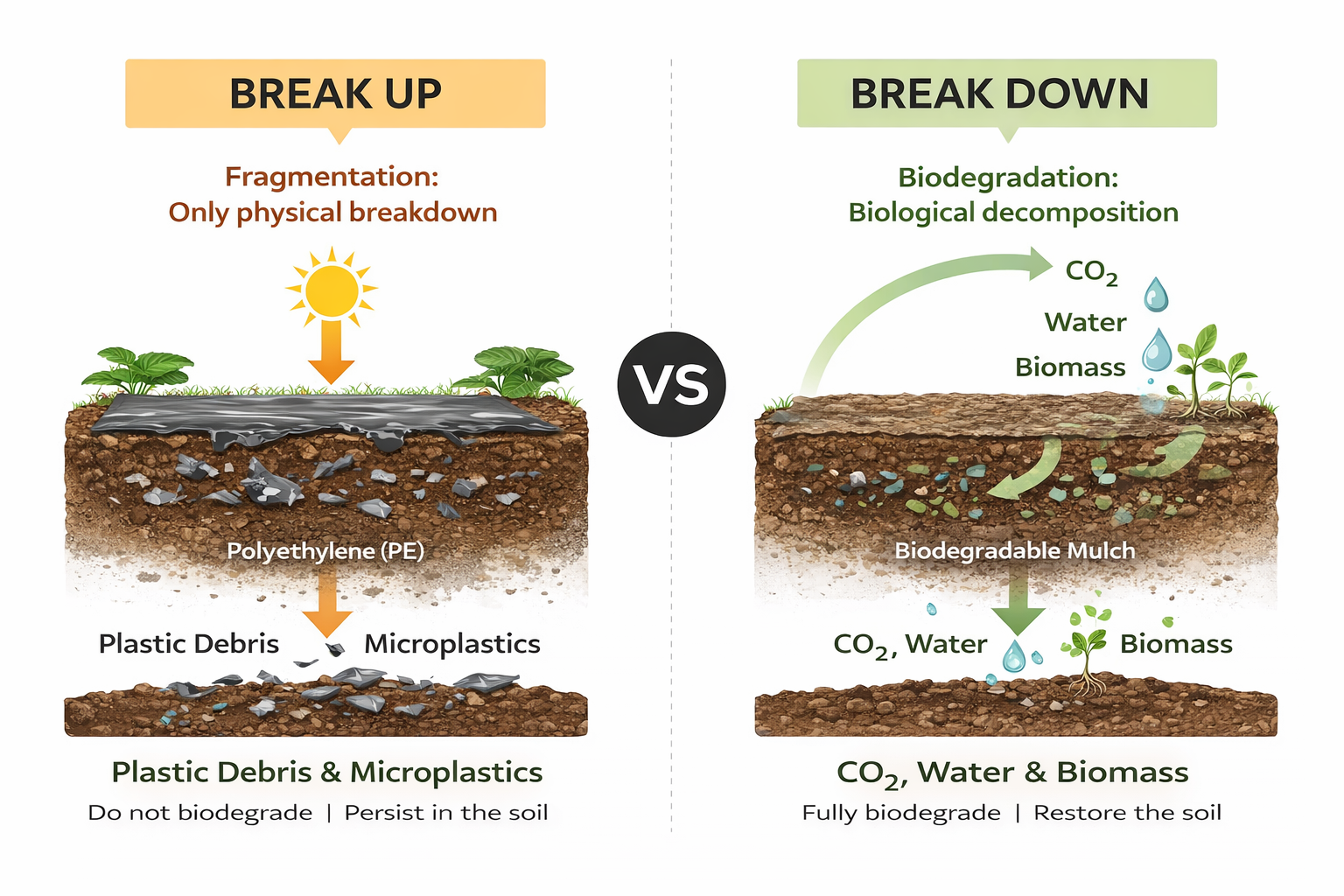
Breaking Apart Is Not the Same as Breaking Down
Conventional polyethylene mulch does not biodegrade.
It does not turn into compost.
It does not become soil.
It does not disappear.
It breaks up.
Sunlight, heat, and mechanical stress make it brittle.
It fractures into smaller and smaller pieces.
Those pieces remain in the soil.
That is fragmentation — not biodegradation.
What Actually Remains in the Field
After removal, growers often notice:
Thin strips left in the bed
Small flakes mixed into soil
Plastic dust after tillage
Even careful removal cannot extract everything.
Over time, repeated use leads to accumulation.
These fragments are called microplastics when they fall below 5 mm.
They do not decompose like organic matter.
They persist.
Why This Matters for Soil
Agricultural soil is a living system.
Microbial activity, structure, water infiltration, and root development all depend on balance.
Plastic fragments:
Do not provide nutrients
Do not improve structure
Do not break down biologically
They remain as inert synthetic particles.
Removal removes sheets.
It does not remove everything.
What True Biodegradable Mulch Does Differently
A properly formulated biodegradable mulch behaves differently.
It is designed to:
Remain stable during the crop cycle
Then biodegrade in soil
Convert into CO₂, water, and biomass
Not fragments.
Not plastic dust.
Actual biological breakdown.
That is the fundamental difference.
If plastic simply breaks apart, it is still plastic.
If it truly breaks down, it becomes part of the soil cycle.
And in agriculture, that difference matters.